Toilets are getting smarter, but that does not mean every new feature is worth paying for.
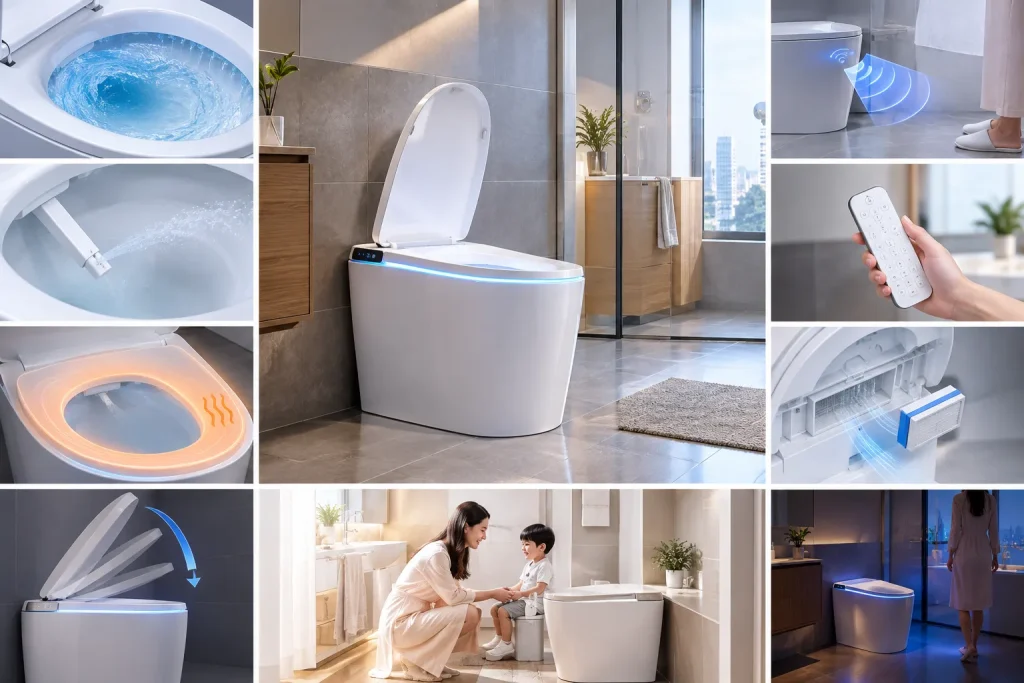
Walk into a bathroom showroom in 2026 and you may see toilets with heated seats, automatic lids, hands-free flushing, built-in bidets, deodorizing systems, nightlights, pre-mist functions, UV cleaning, remote controls, app connectivity, and increasingly sophisticated electronic features.
That sounds impressive. But when you are spending hundreds or even several thousand dollars on a toilet, the more important question is much simpler: Which of these features will actually make everyday life better?
Some upgrades are genuinely useful every day. Others are mostly showroom features that are fun to demonstrate but difficult to justify once the novelty wears off.
This guide breaks down the biggest 2026 toilet trends and looks at them from a homeowner’s perspective: purchase price, installation, maintenance, practical benefits, drawbacks, and how useful each feature is in a real bathroom.
Quick Answer: Which 2026 Toilet Features Are Worth Paying For?
For most homeowners, the best-value upgrades are water efficiency, strong flushing performance, bidet washing, a heated seat, automatic flushing, deodorizing, and a useful nightlight.
Features such as automatic lids, bowl misting, UV cleaning, voice controls, app integration, and advanced health-monitoring technology can be worthwhile, but they should usually come after the core functions are covered.
The biggest mistake is buying a toilet because it has the longest feature list. A better approach is to pay for the features you will use several times a day while keeping reliability, installation, and future maintenance in mind.
2026 Toilet Trends: The Features Homeowners Are Actually Buying
| Feature | Typical Value | Installation | Maintenance | My Verdict |
|---|---|---|---|---|
| Water-efficient flushing | High | Low | Low | Worth paying for |
| Built-in bidet | Very high | Medium to high | Medium | Worth paying for |
| Heated seat | High | Low | Low | Worth paying for |
| Automatic flush | High | Low to medium | Low | Usually worth it |
| Deodorizing system | Medium to high | Low | Medium | Often worth it |
| Nightlight | Medium | Low | Very low | Good-value upgrade |
| Self-cleaning wand | Medium to high | Low | Medium | Worth considering |
| Automatic lid | Medium | Low | Low to medium | Optional |
| UV / advanced cleaning | Medium | Low | Medium | Secondary upgrade |
| App / voice controls | Low to medium | Medium | Medium | Usually optional |
| AI health monitoring | Emerging | Medium | Potentially high | Wait and evaluate |
1. Water Efficiency Is Still One of the Best Toilet Upgrades
Water efficiency may not sound as exciting as an automatic lid, but it is one of the easiest features to justify financially and environmentally.
The U.S. Environmental Protection Agency says toilets account for nearly 30% of an average home’s indoor water consumption. WaterSense-labeled toilets use 1.28 gallons per flush or less and are independently certified for both efficiency and flushing performance. That represents a 20% reduction compared with the current federal 1.6-gallon-per-flush standard.
That last part matters. A low-flow toilet that performs poorly is not a bargain if you end up flushing twice.
Modern toilet engineering has improved substantially, which means an efficient toilet does not have to be weak. EPA’s WaterSense specifications include both water-use requirements and performance criteria, including a solid-waste removal test.
For homeowners replacing an older toilet, the potential savings can be especially significant. EPA’s current calculator uses approximately 5 gallons per flush for toilets installed before 1980, about 3.5 gallons for many toilets installed from 1980 through 1994, and 1.6 gallons for toilets installed after 1994 when estimating replacement savings.
Bottom line: If you are comparing two toilets and one offers reliable flushing at a lower water-use rate, that is usually money well spent.
2. Integrated Bidet Washing Is Probably the Most Meaningful Comfort Upgrade
If you have never used a bidet toilet, it is easy to underestimate how different it feels.
Once you become accustomed to adjustable water temperature, water pressure, spray position, and warm-air drying, going back to a basic toilet can feel surprisingly old-fashioned.
Modern smart toilets commonly combine front and rear washing with heated seating, automatic flushes, deodorizing, and other convenience features. For example, KOHLER’s current smart toilet range includes adjustable water temperature and pressure, bidet washing, automatic deodorization, automatic flushing, heated seats, warm-air drying, and other automated functions.
The practical question is whether you will use the feature regularly. In most homes, the answer is yes. Unlike a decorative lighting feature, a bidet is part of the actual toilet routine.
It can also reduce dependence on toilet paper, although the exact amount depends on personal habits.
Best option for many homeowners: Keep a good existing toilet and install a quality bidet seat. That can deliver much of the comfort improvement without replacing the entire toilet.
Current retail listings also show why this approach can be attractive. KOHLER’s heated bidet seats, for example, currently range from around $300 to more than $1,200 depending on model and features, giving homeowners a way to add premium functions without automatically moving into the price range of a luxury integrated smart toilet.
3. Heated Toilet Seats Are Simple but Surprisingly Useful
Heated seats have been around for years, but they remain one of the best examples of a feature that becomes more valuable after you live with it.
Think about a winter morning when the bathroom feels cold. Sitting on a warm toilet seat is a small comfort, but it happens every time you use the toilet.
Most premium bidet toilets let users select multiple temperature settings, and some systems can manage temperature automatically.
Unlike a complicated smart-home feature, a heated seat is easy to understand and does not require you to change your daily routine.
Verdict: High-value comfort feature, particularly for cold climates, older adults, or households where the bathroom is used frequently.
4. Automatic Flushing Is One of the Better Hands-Free Features
Automatic flushing is practical because it removes one of the most frequently touched parts of a traditional toilet.
A sensor can detect when the user has finished and trigger the flush without requiring a hand to touch the flush button or handle.
That can be particularly convenient in family bathrooms where children sometimes forget to flush.
It is also useful for homeowners who simply prefer a hands-free bathroom experience.
The important point is proportionality. I would happily pay extra for automatic flushing when it comes with other useful smart features. I would not spend several thousand dollars more for automatic flushing alone.
Verdict: Worth paying for as part of a broader smart-toilet package, but rarely worth buying by itself.
5. Automatic Deodorizing Can Be Worth the Extra Cost
Deodorizing systems are easy to dismiss until you live in a bathroom that is used heavily throughout the day.
Most systems use a fan and some form of filtration or air treatment to reduce unpleasant odors around the toilet.
This can be particularly valuable in a small powder room, a shared family bathroom, or a bathroom with limited ventilation.
However, there is a maintenance trade-off. Filters and related components may need periodic cleaning or replacement depending on the system.
Verdict: A useful upgrade for busy or poorly ventilated bathrooms. Less important if your bathroom already has excellent ventilation.
6. Built-In Nightlights Are Small, Cheap, and More Useful Than They Look
A toilet nightlight sounds like a cosmetic feature until you use the bathroom at 2 a.m.
Turning on a bright overhead light in the middle of the night can be unpleasant. A soft toilet-mounted light can provide just enough illumination to locate the toilet and avoid stumbling around in the dark.
This is particularly useful for:
- Homes with young children.
- Older adults.
- People who frequently use the bathroom at night.
- Bathrooms with limited nighttime lighting.
It is also a feature that generally requires very little effort after installation.
Verdict: One of the best low-cost convenience upgrades.
7. Self-Cleaning Bidet Wands Are Useful, but They Do Not Make the Toilet Maintenance-Free
Self-cleaning wand technology has become increasingly common in higher-end bidet toilets.
Depending on the model, the wand may automatically rinse itself after use. More advanced systems can add electrolyzed-water rinsing or UV treatment.
KOHLER’s current smart toilet lineup, for example, includes models with stainless-steel wands, electrolyzed-water rinsing, and UV cleaning technology.
These features are useful, but homeowners should be careful with the phrase “self-cleaning.”
You still need to clean the toilet bowl, seat, exterior surfaces, and surrounding floor. Filters and other components may also require maintenance.
Verdict: Basic automatic wand cleaning is a worthwhile feature. Advanced UV or water-treatment technology is more of a secondary upgrade.
8. Bowl Misting Is Interesting, but I Would Not Make It a Deal-Breaker
Some modern toilets use an automatic mist or pre-wetting function before use. The goal is to reduce the tendency of waste to adhere strongly to the bowl surface.
It is a sensible engineering idea, especially when combined with a smooth ceramic surface and an effective flushing system.
But I would still treat it as a convenience feature rather than an essential one.
When choosing between two otherwise similar toilets, it can be a nice bonus. When it adds a significant amount to the purchase price, I would prioritize flushing, bidet performance, seat comfort, and reliability first.
9. Automatic Lids Are Convenient, but They Are Not Essential
The automatic lid is probably the feature that gets the biggest reaction during a showroom demonstration.
You walk toward the toilet, the lid opens, and it closes after you leave. It looks futuristic.
It is also convenient.
But from a practical standpoint, an automatic lid solves a much smaller problem than a bidet, heated seat, or automatic flush.
There is also a mechanical component involved. A motorized lid has more parts than a manually operated lid, which means more potential components to service eventually.
Verdict: Nice luxury feature. Worth paying for when you already want a premium smart toilet, but not one of my first priorities.
10. App and Voice Controls Are More About Convenience Than Toilet Performance
Connected controls are becoming increasingly common in premium bathroom products.
In theory, controlling a toilet with a smartphone or voice assistant sounds extremely modern.
In practice, you are already sitting within arm’s reach of the toilet’s remote or control panel.
That makes app control far less important than it would be for something like a thermostat or security system that you regularly control from another room.
There is another consideration: software dependence.
If a feature requires an app, cloud service, Wi-Fi connection, or subscription, I always recommend checking what still works when the internet connection disappears.
Verdict: Fun and potentially useful, but rarely a reason by itself to spend much more.
11. AI and Health-Monitoring Toilets Are a Trend to Watch Carefully
One of the more interesting developments around toilets is the move toward health monitoring.
Sensors and other technologies are increasingly being explored for analyzing urine, stool, and other indicators. The idea is to turn the toilet into a passive health-monitoring point.
The concept is fascinating, but homeowners should be careful about confusing consumer technology with medical diagnostics.
There are also questions around privacy, data storage, recurring costs, software support, and the accuracy of any interpretation generated by a consumer device.
My recommendation in 2026: Watch the category, but do not pay a huge premium for health-monitoring functions unless you have a very specific reason to use them and fully understand how the data is collected and handled.
12. What Does a Smart Toilet Actually Cost?
Smart toilet pricing varies dramatically.
A relatively basic toilet may cost several hundred dollars, while a bidet seat can add several hundred to more than $1,000. Premium integrated smart toilets can reach several thousand dollars, with high-end models costing substantially more.
Current KOHLER product information demonstrates how broad the feature range can be, with different smart toilet models offering combinations of automatic flushing, heated seats, bidet washing, nightlights, automatic lids, cleaning technology, remote controls, and other advanced functions.
| Upgrade Path | Cost Level | Installation Complexity | Maintenance | Best For |
|---|---|---|---|---|
| Basic efficient toilet | $ | Low | Low | Simple replacement |
| Efficient toilet + bidet seat | $$ | Low to medium | Low to medium | Best overall value for many homes |
| Mid-range integrated smart toilet | $$$ | Medium | Medium | Primary bathroom upgrades |
| Luxury smart toilet | $$$$+ | Medium to high | Medium to high | Luxury remodels |
These are relative price categories rather than fixed U.S. installation prices. Local labor rates, electrical work, plumbing modifications, the toilet model, and bathroom access can significantly affect the final cost.
13. Installation Is the Hidden Cost Many Buyers Forget
This is where buying a smart toilet differs from buying a conventional toilet.
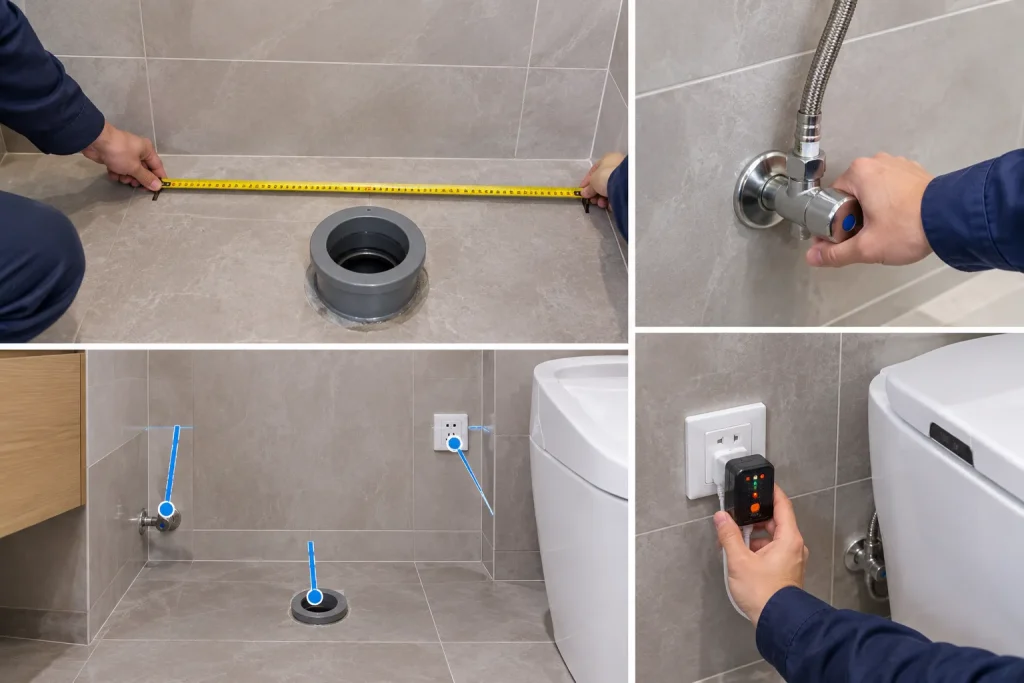
A standard toilet mainly requires the correct drainage connection, water supply, shutoff valve, flange, and rough-in dimensions.
A powered smart toilet can introduce additional requirements, including an electrical receptacle, appropriate bathroom electrical protection, and sufficient space for the control and water connections.
Before ordering, check:
- Toilet rough-in measurement.
- Water-supply location.
- Condition and position of the shutoff valve.
- Electrical outlet location.
- Bathroom electrical requirements and GFCI protection.
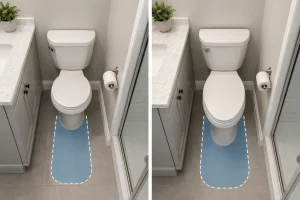
- Available clearance around the toilet.
- Manufacturer-specific installation instructions.
- Emergency operation during a power outage.
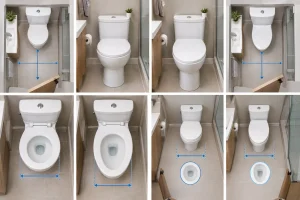
Do not assume a premium smart toilet will automatically fit where your existing toilet sits.
14. What Happens to a Smart Toilet During a Power Outage?
This is one of the questions I recommend asking before buying an expensive electronic toilet.
A traditional gravity toilet will still flush when the electricity is off.
A smart toilet may lose some or all electronic functions depending on its design. Some manufacturers provide battery-powered or emergency flushing solutions on selected models. KOHLER’s current comparison information, for example, lists battery-operated backup flushing on some smart toilets rather than every model.
That difference matters if you live somewhere with frequent power interruptions.
Practical advice: Before buying, read the manufacturer’s instructions for power-loss operation rather than assuming the toilet will behave like a conventional one.
15. Which Toilet Features Make Sense for Different Homes?
For a Small Apartment
Prioritize a compact footprint, reliable flushing, water efficiency, and possibly a bidet seat.
A separate bidet seat can be particularly attractive because you can upgrade or replace the seat later without replacing the entire toilet.
For a Busy Family Bathroom
Automatic flushing, good flushing performance, bidet washing, deodorizing, and a nightlight make the most sense.
When four or five people use the same bathroom throughout the day, convenience features can provide a much better return than they do in a rarely used guest bathroom.
For Older Adults or Aging-in-Place Remodeling
Think beyond smart technology.
Seat height, good lighting, easy-to-read controls, heated seating, hands-free flushing, and reliable bidet controls may all be more valuable than voice commands or smartphone integration.
For a Luxury Primary Bathroom
This is where a premium integrated smart toilet becomes easier to justify.
You may genuinely appreciate having bidet washing, heated seating, automatic flushing, deodorizing, warm-air drying, automated lids, nightlighting, and personalized settings in one integrated unit.
Even here, however, I would still prioritize core performance over novelty features.
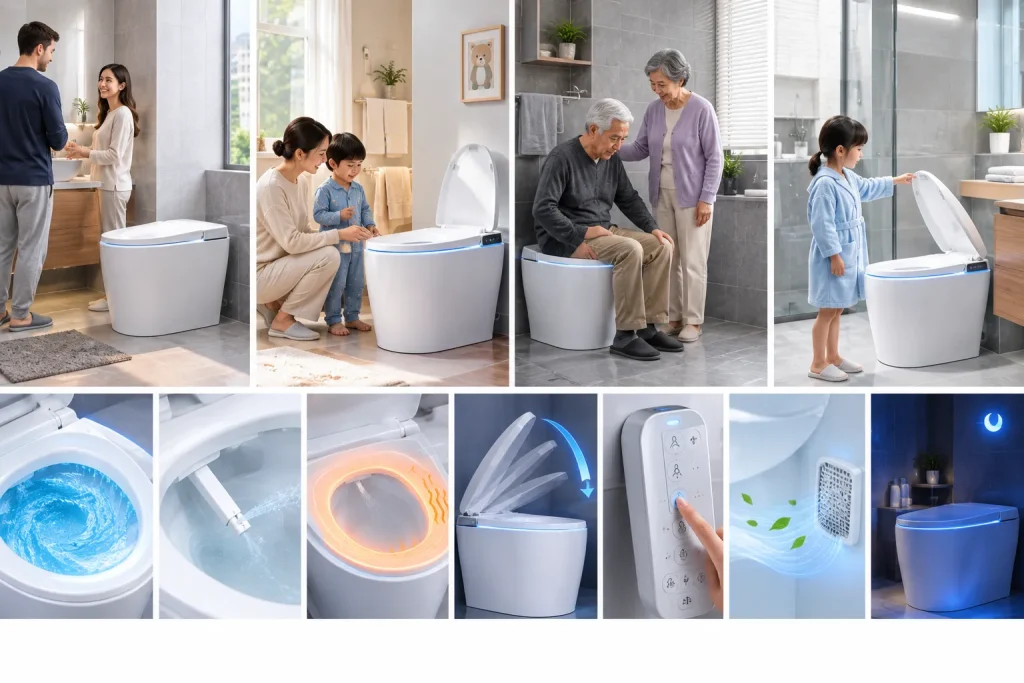
Toilet Repair, Maintenance, and Purchase Guide
16. The Features I Would Prioritize in 2026
- 1. Proven flushing performance — A toilet still has one primary job.
- 2. Water efficiency — Look for independently certified efficiency such as WaterSense in the U.S.
- 3. Bidet washing — One of the most noticeable everyday upgrades.
- 4. Heated seat — Simple comfort with frequent use.
- 5. Automatic flush — Excellent hands-free convenience.
- 6. Deodorizing — Particularly useful in shared bathrooms.
- 7. Nightlight — A small feature with a practical benefit.
- 8. Self-cleaning wand — Helpful for routine hygiene.
- 9. Automatic lid — Nice to have, but not essential.
- 10. Advanced connected features — Consider them only after the basics are right.
17. Which Features Would I Skip on a Tight Budget?
If the budget is limited, I would skip the features that look impressive but make little difference to the daily bathroom routine.
That usually means voice controls, elaborate app integration, decorative lighting, premium lid automation, and advanced health-monitoring functions.
I would rather spend that money on a better flushing system, a quality bidet seat, a more comfortable seat height, better ventilation, or professional installation.
There is an important lesson here: the best toilet is not necessarily the toilet with the most technology.
18. Smart Toilet vs. Traditional Toilet + Bidet Seat
| Factor | Integrated Smart Toilet | Traditional Toilet + Bidet Seat |
|---|---|---|
| Upfront cost | Higher | Usually lower |
| Appearance | Very clean and integrated | More visible components |
| Bidet functionality | Excellent on premium models | Excellent with a good seat |
| Replacement flexibility | Lower | Higher |
| Installation | More specialized | Usually simpler |
| Repair complexity | Higher | Moderate |
| Best use case | New luxury bathroom remodel | Existing good toilet needing an upgrade |
For many homeowners, the second option is the value winner.
You keep a conventional toilet that is relatively easy to service and add the functions you actually care about.
The integrated smart toilet becomes more compelling when aesthetics, space, convenience, and a complete bathroom remodel are more important than minimizing long-term complexity.
19. Frequently Asked Questions
What is the most useful new toilet feature in 2026?
For most homeowners, bidet washing provides the biggest noticeable improvement in everyday use. A heated seat, automatic flush, and deodorizer are also highly practical because they are used repeatedly rather than occasionally.
Are smart toilets worth the money in 2026?
They can be worth it for a primary bathroom, luxury remodel, or household that values integrated bidet functions and automation. For a basic replacement, a WaterSense-labeled toilet combined with a quality bidet seat can often provide better value.
Is a WaterSense toilet still worth buying in 2026?
Yes. EPA continues to describe WaterSense-labeled toilets as a high-performance, water-efficient option, with a maximum flush volume of 1.28 gallons per flush for the applicable tank-type specification.
Do smart toilets cost more to maintain?
They can. A conventional toilet has relatively simple mechanical and plumbing components. A smart toilet adds heaters, sensors, control electronics, pumps, bidet components, and other systems that can make troubleshooting more specialized.
Should I buy a smart toilet or install a bidet seat?
If your current toilet flushes well, fits the bathroom properly, and is in good condition, a quality bidet seat is often the better-value upgrade. A complete smart toilet makes more sense during a larger bathroom renovation or when you want an integrated appearance.
Conclusion
The biggest 2026 toilet trend is not simply that toilets are becoming smarter. It is that homeowners now have more ways to spend money on bathroom technology than ever before.
That makes prioritization more important.
For most households, I would put water efficiency, reliable flushing, bidet washing, heated seating, automatic flushing, deodorizing, and useful lighting ahead of voice controls, elaborate app features, automatic lids, and experimental health-monitoring technology.
The best purchase is the one that improves the bathroom every time you use it without creating unnecessary installation or maintenance headaches.
In other words, do not ask, “What is the smartest toilet available in 2026?”
Ask, “Which features will genuinely make my bathroom better for the people who use it every day?”