Seeing water pool around your bathroom floor drain is one of those small problems that is easy to ignore at first. A little standing water after a shower may seem harmless, especially if it disappears later. But when the water stays for several minutes, returns every time you use the bathroom, or starts spreading across the floor, it is worth finding out why.
The cause is not always a clogged drain. Slow drainage, an incorrectly sloped bathroom floor, debris around the drain cover, a partially blocked trap or drain line, and even a damaged or poorly detailed shower area can all contribute to standing water.
The good news is that many causes are relatively simple to diagnose. The important part is to distinguish a normal temporary puddle from water that indicates a drainage or waterproofing problem.
Quick Answer: Why Is Water Pooling Around the Floor Drain?
The most common reason is that water is reaching the floor drain faster than the drain can carry it away.
That can happen because of:
- A partially clogged or slow floor drain
- Hair, soap residue, and dirt around or below the drain cover
- A poorly sloped bathroom floor that does not direct water toward the drain
- A partially blocked trap or branch drain
- A drain connection or seal problem
- Water entering the bathroom faster than the drainage system was designed to handle
- A more serious plumbing or waterproofing problem beneath the finished floor
If the water disappears quickly once you stop using the shower or sink, the problem may be relatively minor. If water remains for a long time, backs up when another fixture is used, produces a sewer odor, or appears even when nobody has used the bathroom, the situation deserves more attention.
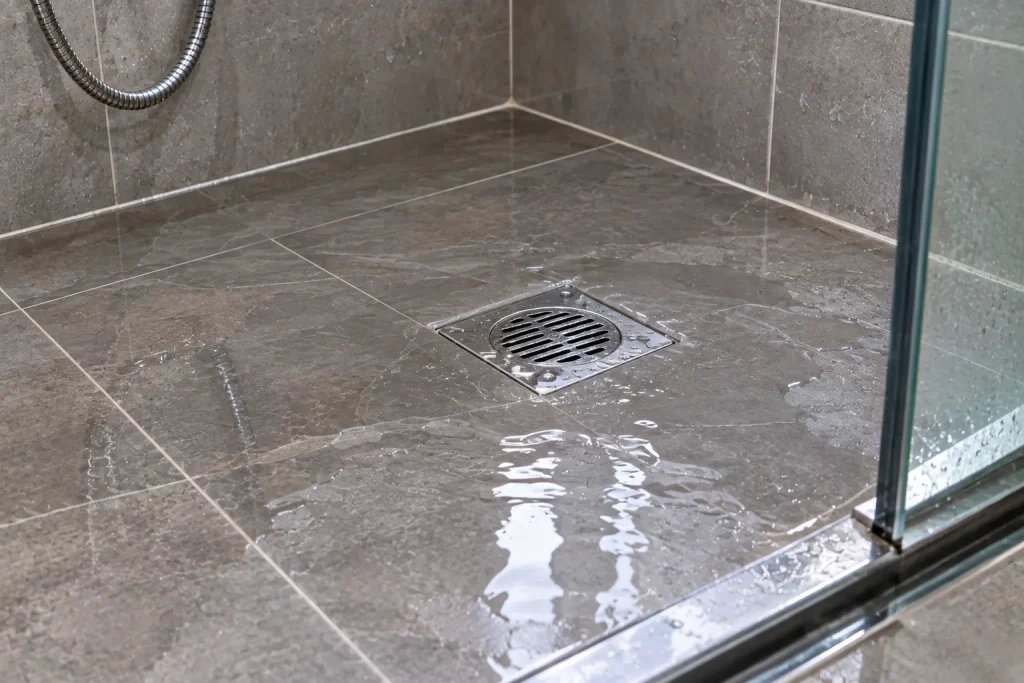
1. The Floor Drain Is Partially Clogged
A partial clog is one of the first things I would check.
Unlike a completely blocked drain, a partially restricted drain may still allow water to disappear eventually. That is why homeowners sometimes assume everything is working normally.
Over time, hair, soap residue, lint, body oils, dirt, and small particles can collect inside the drain. In a shower, hair is especially common because it can catch around the drain opening and gradually build a larger restriction.
The typical pattern is easy to recognize: the water drains normally at first, then starts accumulating around your feet as the shower continues.
2. The Drain Cover or Drain Opening Is Blocked
Sometimes the problem is much simpler than a blocked pipe.
Dust, hair, soap film, and other debris can collect directly around the drain cover. If the opening area becomes restricted, the effective drainage capacity is reduced.
Before using chemical drain cleaners, remove the cover if it is designed for homeowner access and inspect the opening. A basic physical cleaning is often a better first step because you can actually see what is causing the restriction.
3. The Bathroom Floor Does Not Have Enough Slope
This is a different problem because the drain itself may be working perfectly.
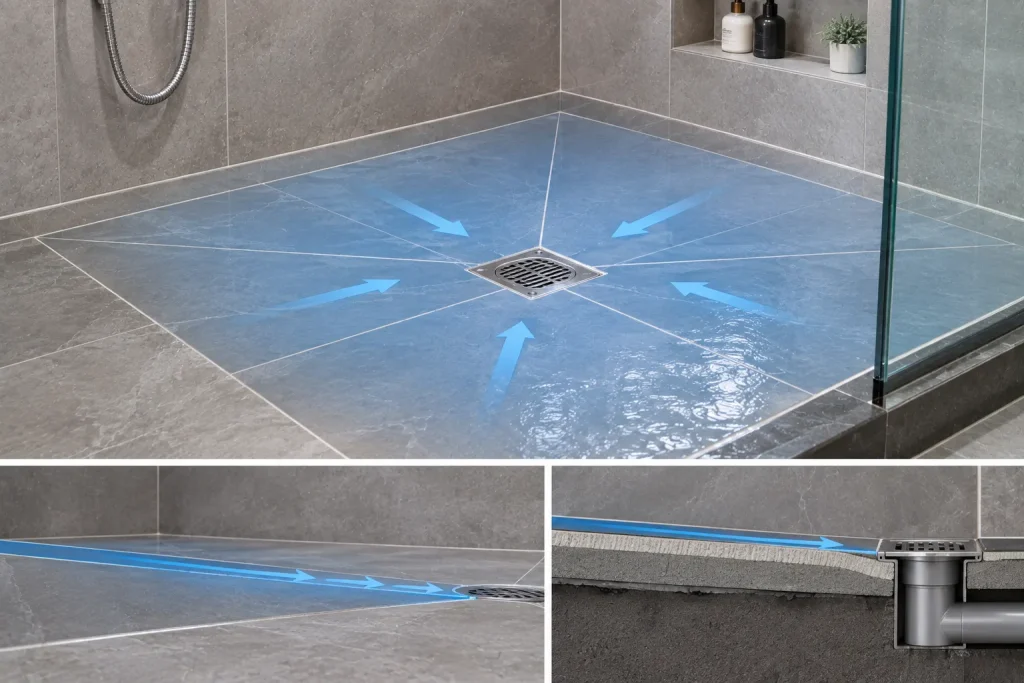
Bathroom floors in wet areas are normally designed so water moves toward the drain rather than remaining flat across the finished surface. If the slope is insufficient, inconsistent, or has changed during a remodel, water may sit in low spots around the drain.
This can be particularly noticeable after bathroom renovations.
For example, a shower may drain reasonably well, but a shallow depression near one edge of the drain can leave a small puddle after every shower. The drain is not necessarily clogged. The problem is that gravity is not moving all the surface water efficiently toward the drain.
This is one reason a drain that was never a problem before a renovation may suddenly appear to “work badly” afterward.
4. The Drain Trap or Branch Line Is Partially Blocked
The restriction may be farther down the drainage path.
A partial obstruction inside the trap or branch drain can reduce flow without completely stopping the drain. You may notice that the water level rises during a shower and then slowly falls once the water supply stops.
If other fixtures in the same bathroom also drain slowly, that is a useful clue.
For example, if the shower floor drain is slow and the bathroom sink starts draining slowly at the same time, the problem may be farther downstream rather than directly underneath the floor drain.
5. The Bathroom Drain Is Overloaded During Use
Sometimes the drainage system is functioning normally, but the water enters the floor area faster than the drain can remove it.
A shower produces a continuous flow of water rather than a few isolated drops. If the shower head has a higher flow rate and the drain is already partially restricted, the result can be temporary pooling.
The key question is what happens after the water stops.
If the puddle disappears quickly and does not return when the drain is clean, the system may simply have a limited drainage rate. If the water remains noticeably longer than expected or backs up repeatedly, look for an underlying restriction.
6. The Drain Body or Seal May Have a Problem
A floor drain is more than the visible grate on the floor. Beneath that opening is a drain assembly that connects to the plumbing system.
If the drain body, connection, or surrounding waterproofing detail was installed incorrectly, damaged, or disturbed during remodeling, water may not behave as expected around the drain.
This becomes more concerning when you notice other symptoms such as:
- Persistent dampness around the drain area
- Water appearing underneath the finished surface
- Staining on the ceiling below
- A musty smell that does not go away
- Repeated moisture problems despite cleaning the drain
At that point, treating the issue as a simple clog may delay the real repair.
7. The Bathroom Floor May Have a Low Spot
A low spot is especially easy to notice in large bathrooms with a central floor drain.
Imagine that the rest of the floor is reasonably sloped toward the drain, but one small section is slightly lower than the surrounding area. Water can collect there even though the drain itself is completely clear.
This is common in situations where tile has been replaced or the underlying mortar bed was altered.
A small puddle does not automatically prove a waterproofing failure. It may simply indicate a surface drainage or floor-leveling issue. However, persistent standing water increases the time that grout, sealants, and surrounding materials remain wet.
How to Tell Whether the Problem Is a Drain Clog or Floor Slope
| What You Notice | More Likely Cause | What to Check First |
|---|---|---|
| Water rises during showering but drains slowly afterward | Partial clog or restricted drain | Drain cover, trap, and branch drain |
| Only one low area stays wet after the rest of the floor dries | Floor slope or low spot | Surface drainage pattern |
| Multiple bathroom fixtures drain slowly | Downstream plumbing restriction | Shared drain line |
| Water appears even when the bathroom is not being used | Leak or water intrusion | Nearby plumbing and surrounding areas |
| Sewer odor accompanies slow drainage | Drain or trap problem | Trap and drainage system |
| Water damage appears below the bathroom | Leak, failed connection, or waterproofing problem | Plumbing and waterproofing assembly |
A Simple Homeowner Test for a Slow Bathroom Floor Drain
You can perform a basic observation test without taking the floor apart.
First, remove visible debris around the drain opening. Then run a moderate amount of water into the area and watch how quickly the water moves toward the drain.
Next, stop the water and observe how the puddle disappears.
Pay attention to three things:
- How quickly water reaches the drain
- Whether the water rises significantly during flow
- How long the remaining puddle takes to disappear
You can also compare different parts of the bathroom floor. If water consistently remains in one particular location while the surrounding floor dries normally, the issue may be related to floor slope rather than a clogged pipe.
Should You Use Chemical Drain Cleaner?
I would not make chemical drain cleaner the first solution for a bathroom floor drain problem.
A physical obstruction can often be identified and removed more effectively without pouring an aggressive chemical into the plumbing system. Chemical products can also complicate later maintenance if a plumber needs to work on the drain.
For a basic household problem, start with inspection and mechanical cleaning. If the blockage is deeper in the line or keeps returning, professional drain cleaning may be more appropriate.
What Happens If You Ignore Water Pooling?
A small puddle may not cause immediate structural damage, but persistent moisture should not be ignored.
Repeated standing water keeps grout and sealant wet for longer periods and can contribute to staining, odor, deterioration of some materials, and recurring moisture problems.
In a properly constructed wet area, the waterproofing system is intended to manage incidental water that gets past the surface. However, waterproofing is not a substitute for proper surface drainage.
Tile is the visible finish, not the complete waterproofing system. Water management depends on the entire assembly, including the floor slope, waterproofing layer, drain connection, transitions, and surrounding details.
For more expert resources, explore our Bathroom Waterproofing category, where we cover materials, repair methods, and prevention strategies in depth.
Real-World Example: A Shower That Always Leaves a Small Puddle
Consider a homeowner who remodeled a bathroom and noticed a small puddle beside the floor drain after every shower.
The homeowner initially assumed the drain was clogged because the puddle kept appearing. After cleaning the drain, the problem remained.
During a closer inspection, it became clear that the water was not backing up from the drain. Instead, most of the bathroom floor dried normally while one shallow area continued to hold water.
That points toward a surface slope problem rather than a simple blockage.
This distinction matters because repeatedly cleaning the drain will not correct a low spot in the floor.
Another Scenario: Water Rises Around the Drain During a Shower
Now consider a different bathroom.
The homeowner starts the shower and notices that water slowly builds up around the drain. When the shower is turned off, the water level gradually falls over the next several minutes.
This pattern is much more consistent with restricted drainage.
In that situation, the first areas to investigate are the drain opening, trap, and downstream line rather than immediately assuming the bathroom waterproofing has failed.
What If Water Appears Around the Drain When No One Is Showering?
This is more concerning.
If water appears around the bathroom floor drain even when nobody is using the shower, sink, or tub, you need to consider other sources of water.
Possible causes include:
- A leaking nearby water supply or drain pipe
- Water coming from another fixture
- A plumbing leak below the floor
- Water migration from an adjacent wet area
- Moisture entering from outside the bathroom
In a multi-story home, check the ceiling or room below for new staining, discoloration, bubbling paint, or dampness.
If the moisture pattern continues without normal bathroom use, it is better to investigate the source promptly rather than assuming the floor drain is responsible.
When Should You Call a Plumber?
A professional inspection becomes more reasonable when the problem keeps returning after basic cleaning or when multiple symptoms appear together.
Examples include:
- The drain repeatedly backs up after cleaning
- Several fixtures in the bathroom are draining slowly
- You hear gurgling from the drain
- There is a persistent sewer odor
- Water appears when the bathroom is not being used
- There is visible water damage below the bathroom
- The problem started immediately after major remodeling
These signs can point to a deeper drainage problem, a damaged connection, venting issues, or a waterproofing/detailing problem that is beyond a simple drain cleaning.
How Much Could the Repair Cost?
The cost depends heavily on what is actually causing the water to pool.
| Potential Problem | Typical Repair Difficulty | Potential Cost Consideration |
|---|---|---|
| Debris around drain opening | Low | Usually a simple homeowner maintenance task |
| Simple drain cleaning | Low to moderate | Generally less expensive than opening walls or flooring |
| Deeper drain blockage | Moderate | Professional drain equipment may be needed |
| Incorrect floor slope | High | May require tile and underlayment work |
| Damaged drain connection | Moderate to high | Depends on access and extent of repair |
| Waterproofing failure | High | May require partial or extensive bathroom reconstruction |
There is no useful single national price for these repairs because labor rates, access conditions, bathroom construction, and regional contractor pricing vary substantially.
How to Prevent Water From Pooling Around the Bathroom Drain
Prevention starts with keeping the drainage system clear and making sure surface water has a reliable path to the drain.
- Remove hair and visible debris regularly
- Keep the drain cover clean
- Watch for gradually slowing drainage
- Address recurring backups early
- Inspect grout and sealant where appropriate
- Pay attention to puddles that remain after the rest of the floor dries
- During a remodel, confirm that the wet-area floor and drain assembly are properly detailed
For shower renovations, the drain should be treated as part of the complete water-management system rather than as an isolated plumbing component.
How to Decide What Is Wrong Based on Your Situation
| Your Situation | Most Practical First Step |
|---|---|
| Only a little water remains for a short time | Monitor the drainage and clean the drain opening |
| Water rises while showering | Inspect for a partial clog |
| One section of floor always stays wet | Check for a low spot or poor slope |
| Sink and shower both drain slowly | Investigate the shared drainage path |
| Water appears without using the bathroom | Look for a plumbing or water-intrusion source |
| Problem began after a remodel | Review drain installation, floor slope, and waterproofing details |
Frequently Asked Questions
Why does water pool around my bathroom floor drain after a shower?
The most common causes are restricted drainage, debris in the drain, poor floor slope, or a low spot near the drain. If the water disappears slowly after the shower stops, a partial blockage is worth checking first.
Is water pooling around a floor drain always a sign of a clogged drain?
No. A properly functioning drain can still leave water behind if the bathroom floor is not sloped correctly or if a low spot prevents surface water from reaching the drain efficiently.
Why does my bathroom floor drain smell bad and hold water?
Standing water combined with a sewer odor can indicate a drainage or trap problem. Hair, organic buildup, partial blockages, or issues farther down the drain line can all contribute.
Should I worry if water appears around the floor drain when the bathroom is not being used?
Yes. Water appearing without normal bathroom use deserves investigation because the source may be a plumbing leak, water migration, or another moisture source rather than the floor drain itself.
Can poor bathroom waterproofing cause water to pool around a floor drain?
Waterproofing problems can contribute to moisture-related symptoms, but surface pooling is often more directly related to drainage capacity or floor slope. Waterproofing and surface drainage perform different jobs, so both should be evaluated when a persistent moisture problem develops.
Conclusion
Water pooling around a bathroom floor drain does not automatically mean you have a major plumbing or waterproofing failure.
In many cases, the cause is a partial clog, debris around the drain, or a floor that does not direct water efficiently toward the drain. The pattern of the water tells you a lot: water that rises during use and drains slowly points more toward a restriction, while water that remains in one specific low area points more toward a slope problem.
The situation becomes more serious when multiple fixtures drain slowly, sewer odors appear, water shows up without bathroom use, or there are signs of moisture damage below the floor.
The best approach is to identify whether the water is failing to reach the drain, failing to pass through the drain, or coming from somewhere else entirely. That simple distinction can prevent an unnecessary repair and help you address the real problem before it becomes more expensive.