Choosing a toilet for a small bathroom is not just about finding a toilet that fits the plumbing connection. The shape of the bowl can make a noticeable difference in how much usable space remains in front of the toilet and how comfortable the room feels.
For many small bathrooms, the decision comes down to two common options: a round toilet bowl or an elongated toilet bowl.
A round bowl usually has a shorter front-to-back footprint, while an elongated bowl extends farther forward. That extra length can improve comfort, but in a tight bathroom it may reduce the space available for your knees, the bathroom door, or other fixtures.
So which shape works best?
For most genuinely space-constrained bathrooms, a round toilet is the safer starting point. But an elongated toilet can still be the better choice when the room has enough front clearance and comfort is a higher priority.
Quick Answer: Which Toilet Bowl Shape Is Best for a Small Bathroom?
Choose a round toilet when your main goal is to save floor space.
Choose an elongated toilet when you can spare a little more front-to-back space and want better sitting comfort.
The important part is that toilet bowl shape is only one dimension. You also need to consider the toilet’s overall depth, rough-in, tank width, seat position, bathroom door swing, vanity location, and required clearances.
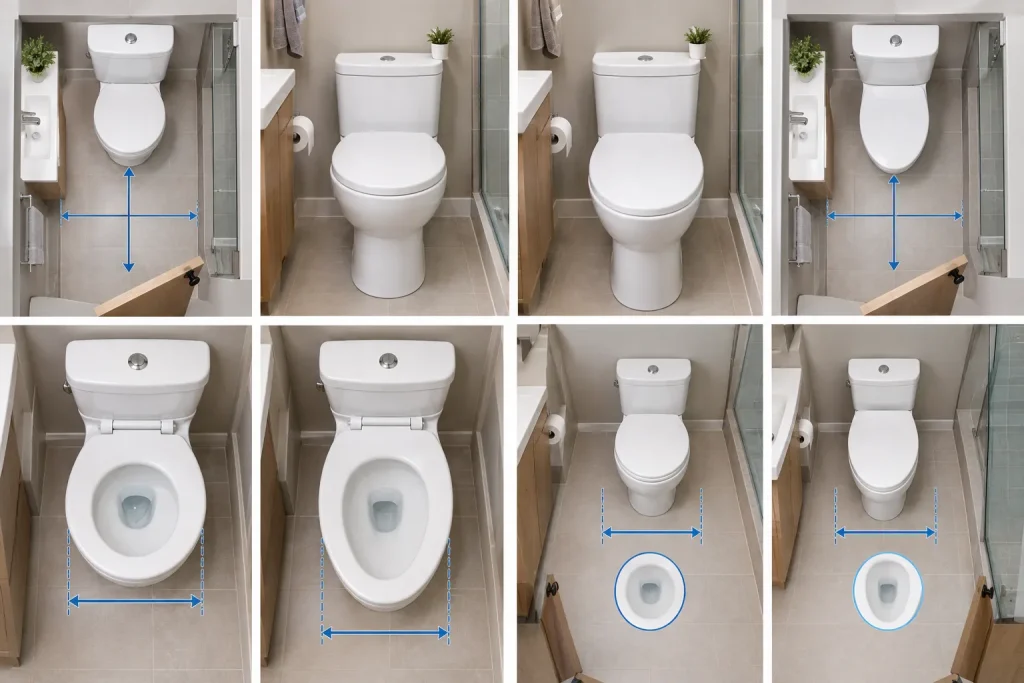
Round vs Elongated Toilets at a Glance
| Feature | Round Toilet | Elongated Toilet |
|---|---|---|
| Overall footprint | Usually shorter from the wall toward the front | Usually extends farther forward |
| Best advantage | Space saving | Comfort |
| Small bathroom fit | Usually easier | Requires more careful measuring |
| Legroom while seated | Generally more compact | Generally more generous |
| Door clearance | Often easier to maintain | Can become a concern in tight layouts |
| Appearance | Traditional and compact | Longer, more contemporary profile |
| Best for | Very small bathrooms and powder rooms | Small-to-medium bathrooms with adequate clearance |
Why Toilet Shape Matters More in a Small Bathroom
In a large bathroom, an extra few inches of toilet depth may not matter much.
In a compact bathroom, those same inches can affect whether you can comfortably stand in front of the toilet, open the door without hitting the bowl, or move between the toilet and vanity.
This is why a homeowner should think about the toilet as part of the entire room rather than as an isolated fixture.
A toilet that technically fits the rough-in can still make a small bathroom feel cramped.
What Is a Round Toilet Bowl?
A round toilet bowl has a more compact front profile. From the wall toward the front edge of the bowl, it generally occupies less space than a comparable elongated model.
This makes round toilets particularly useful in older homes, compact guest bathrooms, half baths, and bathrooms where the door or vanity is close to the toilet.
They have been used in American homes for decades, so replacement seats and other common service parts are generally easy to find.
What Is an Elongated Toilet Bowl?
An elongated toilet bowl has a longer oval-shaped front profile.
The additional bowl length generally provides more support and sitting area, which many adults find more comfortable.
The trade-off is simple: that comfort usually requires more front-to-back space.
An elongated toilet can work perfectly well in a small bathroom, but the room needs to be measured more carefully before purchase.
How Much Space Does a Small Bathroom Toilet Need?
There is no single toilet depth that works for every small bathroom.
The dimensions that matter most are the toilet’s actual projection from the finished wall, the rough-in distance, the available floor width, and the clear space around the fixture.
Do not assume that two toilets with the same bowl shape have the same footprint.
For example, one compact elongated toilet can be noticeably shorter than another elongated model because of differences in tank design, bowl geometry, and overall engineering.
Always compare the manufacturer’s actual rough-in, overall depth, overall width, and required clearances rather than shopping by “round” or “elongated” alone.
Round Toilet: The Main Advantage in a Tight Bathroom
The biggest benefit of a round toilet is front-to-back space.
This can be extremely useful when:
- The bathroom door opens toward the toilet
- The vanity is directly beside the toilet
- The room has a narrow walkway
- The toilet is installed in a small powder room
- The homeowner needs to maximize the open floor area in front of the fixture
In these situations, a compact round toilet can make the room feel noticeably less crowded.
Elongated Toilet: The Main Advantage in a Small Bathroom
The main advantage of an elongated toilet is comfort.
For many adults, the longer bowl provides a more natural seating position and more support.
This can matter in a primary bathroom where the toilet is used many times every day.
Some homeowners are willing to sacrifice a little floor space for better comfort, especially when the bathroom layout already provides sufficient clearance.
Real-World Scenario: A Narrow Guest Bathroom
Imagine a small guest bathroom in an older American home. The toilet sits opposite the entrance, and the bathroom door swings inward.
The vanity is only a short distance away.
In this situation, a deep elongated toilet may create a frustrating pinch point. You might technically have enough room to install it, but opening the door fully could become difficult.
A shorter round toilet would usually be the more practical choice because preserving usable floor space matters more than maximizing bowl length.
Real-World Scenario: A Small Primary Bathroom
Now imagine a compact primary bathroom used by two adults every day.
The toilet has a comfortable amount of space in front of it, and the door does not interfere with the bowl.
Although the bathroom is small, the overall layout allows enough room for an elongated bowl.
In that case, choosing elongated may make more sense because the homeowner can gain additional seating comfort without creating a serious space problem.
Round vs Elongated: Which Is Better for Door Clearance?
Door clearance is one of the easiest details to overlook.
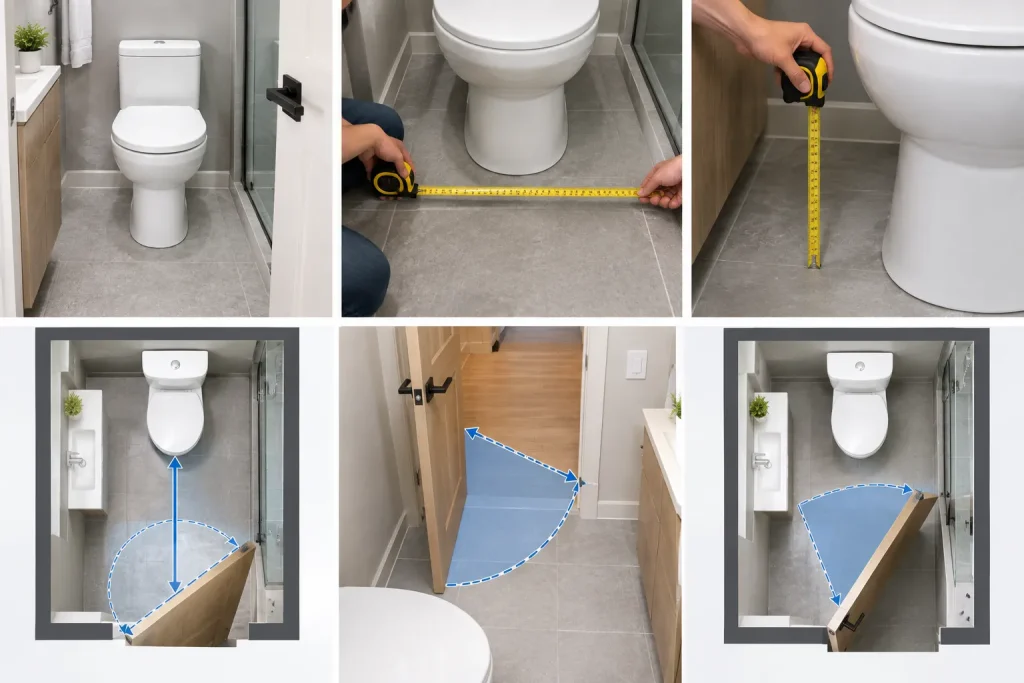
Homeowners often measure the distance from the wall to the toilet but forget to model the full movement of the door.
Suppose the toilet is 2 inches deeper than the previous fixture. That may sound insignificant. But if the door already passes close to the bowl, those extra inches can determine whether the door clears the toilet comfortably.
In a small bathroom, physically swinging the door while measuring the toilet footprint is more useful than simply looking at the floor plan.
Which Bowl Shape Is Easier to Clean?
Neither shape automatically wins on cleaning.
Cleaning performance depends more on the bowl’s surface, rim design, flush system, trapway, water distribution, and how much exposed area is accessible during routine cleaning.
A round toilet can be easier to reach around in a very tight room simply because the fixture is more compact.
An elongated bowl provides a larger front profile, but that does not necessarily make it harder to maintain.
When comparing models, look beyond bowl shape and consider the complete design.
Does Bowl Shape Affect Flushing Performance?
Bowl shape alone does not determine flushing performance.
Flush performance depends on the overall hydraulic design, including the flush valve, water delivery, bowl geometry, trapway, and waste-removal characteristics.
A well-designed round toilet can flush very effectively, and an elongated toilet can also provide strong performance.
This means there is no good reason to choose a round toilet solely because you assume it will flush better in a small bathroom.
Does Bowl Shape Affect Water Efficiency?
Not directly.
Water efficiency is primarily determined by the toilet’s flushing technology and flush volume rather than whether the bowl is round or elongated.
For homeowners who want an efficient toilet, the more useful comparison is the toilet’s rated flush volume and whether it carries a recognized efficiency certification such as EPA WaterSense.
That means you can look for a water-efficient round toilet or a water-efficient elongated toilet depending on the room layout.
What About Comfort Height and Bowl Shape?
Comfort height and bowl shape are separate decisions.
A toilet can be round and comfort height, or elongated and comfort height.
For homeowners with knee or mobility concerns, the sitting height may matter more than whether the bowl is round or elongated.
However, increasing the toilet height does not necessarily solve a depth problem. You still need to measure the complete footprint of the fixture.
How to Measure for the Right Toilet Shape
Before buying a new toilet, measure the bathroom in several directions.
Measure the Rough-In
Measure from the finished wall behind the toilet to the center of the floor drain or closet bolts according to the measurement method appropriate for your existing installation.
Do not measure from an unfinished wall if the wall covering has not yet been accounted for.
Measure Toilet Depth
Check the manufacturer’s published overall depth, not just the bowl depth.
The tank can extend differently depending on the toilet design, so compare the complete assembled footprint.
Measure Front Clearance
Look at the available floor space directly in front of the toilet.
This area needs to work for normal standing, sitting, cleaning, and door movement.
Measure Side-to-Side Space
Check the distance between the toilet and nearby walls, vanity cabinets, shower enclosures, and other fixtures.
A deeper toilet can make an already narrow bathroom feel considerably more confined.
Compare the Actual Product Dimensions
Once you have measured the room, compare at least two or three toilet models using the manufacturer’s dimension drawings.
This is where many homeowners discover that a compact elongated toilet may fit better than a bulky round model, or that a particular round toilet is not actually as compact as expected.
What Toilet Features Matter More Than Bowl Shape?
| Feature | Why It Matters in a Small Bathroom |
|---|---|
| Overall depth | Directly affects floor space and door clearance |
| Rough-in | Determines whether the toilet fits the existing plumbing location |
| Bowl shape | Influences comfort and front-to-back footprint |
| Tank size | Can affect the toilet’s total projection and visual bulk |
| Seat height | Can affect comfort and ease of use |
| Flush system | Affects flushing performance and water use |
| Bowl and base design | Can affect cleaning access and appearance |
When an Elongated Toilet Is Still the Better Choice
Do not automatically reject elongated toilets just because your bathroom is small.
An elongated toilet can be a very good choice when:
- The bathroom has sufficient space in front of the toilet
- The door swing does not interfere
- The homeowner prioritizes seating comfort
- The vanity and shower location leave enough walking space
- A compact elongated model has dimensions that fit the room
In fact, a carefully selected compact elongated toilet may be a better long-term choice than an oversized round toilet that simply happens to be labeled as space-saving.
When a Round Toilet Is Clearly the Better Choice
A round toilet becomes more attractive when every inch matters.
Consider a bathroom where the toilet is only a short distance from the door and there is limited space between the toilet and vanity.
Reducing the toilet’s front projection can create a more usable walkway and make the bathroom feel less congested.
For this type of layout, the small reduction in seating area may be a reasonable trade-off for better room circulation.
Toilet Repair, Maintenance, and Purchase Guide
Round vs Elongated Toilet: Pros and Cons
| Type | Pros | Cons |
|---|---|---|
| Round | More compact, often better for tight layouts, useful for powder rooms | Less sitting area and potentially less comfortable for some adults |
| Elongated | More sitting area, often preferred for adult comfort, widely available | Usually requires more front-to-back space |
What About Small Half Bathrooms?
Half bathrooms often favor compact toilets because there may be limited room for the toilet, sink, and door swing.
A round toilet can be particularly practical when the powder room is extremely narrow.
However, compact elongated toilets should not be dismissed. If the manufacturer’s dimensions allow adequate clearance, an elongated bowl can still work very well.
The best decision comes from measuring the entire layout rather than choosing based on bowl shape alone.
What About Bathrooms With an Outward-Swinging Door?
This layout gives you more flexibility because the door does not need to clear the toilet inside the room.
In that situation, an elongated toilet becomes easier to accommodate.
If you prefer an elongated bowl for comfort, an outward-swinging door can remove one of the biggest space conflicts found in compact bathrooms.
What About a Bathroom With a Vanity Directly Beside the Toilet?
This is where total fixture width and side clearance become important.
An elongated bowl does not necessarily create a side-to-side problem, but its larger front projection may make the area between the toilet and vanity feel tighter.
For a narrow bathroom, compare the complete toilet footprint with the vanity depth. Sometimes changing the vanity depth by a small amount provides more practical improvement than changing from elongated to round.
Should You Choose Round or Elongated for an Older Home?
Older homes often have compact bathroom layouts, which can make round toilets attractive.
At the same time, you should not assume an old bathroom requires a round bowl.
The key is to verify the rough-in and available clearance before buying. If the plumbing location and room dimensions support an elongated model, there is no technical reason an older home cannot use one.
During a renovation, this is also a good opportunity to reconsider the door swing, vanity depth, and fixture placement instead of treating the existing layout as fixed.
Common Mistakes When Choosing a Toilet for a Small Bathroom
Choosing by Bowl Shape Alone
“Round saves space” is generally useful advice, but it is not enough.
Different manufacturers produce different toilet dimensions, so a compact elongated model may fit better than a large round model.
Ignoring the Door Swing
Measure the actual arc of the door instead of guessing.
Forgetting the Vanity
The toilet may fit perfectly on its own but make the walkway between the toilet and vanity uncomfortably narrow.
Not Checking the Rough-In
A toilet that has the right bowl shape can still be incompatible with your plumbing location.
Buying Based Only on Appearance
A toilet can look compact in a showroom photograph while having a surprisingly deep tank or base.
Always check the dimension drawing before ordering.
How to Make an Elongated Toilet Work in a Small Bathroom
If you prefer the comfort of an elongated bowl, there are several ways to make the layout more workable.
- Choose a compact elongated toilet rather than a standard deep model.
- Use a shallower vanity.
- Consider an outward-swinging bathroom door where appropriate.
- Keep the area directly in front of the toilet clear.
- Compare complete fixture dimensions before purchasing.
- Consider wall-mounted or other space-saving fixture configurations only when the plumbing and construction support them.
The goal is not simply to fit the toilet. The goal is to preserve comfortable movement through the bathroom.
Frequently Asked Questions
Is a round or elongated toilet better for a very small bathroom?
A round toilet is usually the safer choice when front-to-back space is extremely limited. An elongated toilet can still work when the room provides adequate clearance and a compact model is selected.
Does a round toilet save a lot of space?
It can save useful front-to-back space compared with a similarly designed elongated toilet. In a very tight bathroom, even a modest reduction in projection can improve door clearance and room circulation.
Are elongated toilets more comfortable than round toilets?
Many adults prefer elongated bowls because they provide a larger seating area. However, comfort is personal, and toilet height and overall seat design also influence how comfortable a toilet feels.
Can an elongated toilet fit in a small bathroom?
Yes. The bathroom does not have to be large. The critical factors are the toilet’s actual depth, rough-in, door movement, side clearances, and the location of nearby fixtures.
Which is easier to install, a round or elongated toilet?
Neither shape is inherently much easier to install. Installation depends more on the rough-in, flange condition, toilet design, access, and whether the existing plumbing needs modification.
Conclusion
So, what toilet bowl shape works best in a small bathroom?
For a very tight bathroom, a round toilet is usually the most practical choice because its shorter front-to-back profile helps preserve floor space.
But that does not mean an elongated toilet is automatically wrong. If the room has enough clearance, a compact elongated toilet can provide better comfort without creating a serious space problem.
The most reliable way to choose is to measure the complete bathroom first, then compare the actual dimensions of several toilet models.
Check the rough-in, overall depth, front clearance, door swing, vanity location, and side clearances before you choose the bowl shape.
In a small bathroom, the best toilet is not necessarily the smallest toilet. It is the toilet that gives you the best balance between usable space, comfort, and proper fit.