
A toilet handle should be simple: press it down, release it, and the handle should return to its normal position while the toilet finishes flushing.
So when the handle sticks after flushing, feels loose, moves slowly, or stays partially pressed, it can be surprisingly frustrating. In some cases, the toilet still flushes normally. In others, a sticking handle can keep the flush valve open and cause the toilet to keep running.
The good news is that a sticking toilet handle is usually caused by a relatively small mechanical problem rather than a major plumbing failure. The handle itself may be dirty or worn, the mounting nut may be too tight, the lift arm may be rubbing against the tank, or the chain connecting the handle to the flush valve may have the wrong amount of slack.
This guide explains how to find the cause, what you can check yourself, what replacement parts usually solve the problem, and when the problem is a sign that the toilet should be serviced more thoroughly.
Quick Answer: Why Does a Toilet Handle Stick After Flushing?
The most common causes are a stiff or worn handle assembly, an overtightened mounting nut, a bent lift arm, a misaligned chain, or a flush valve that does not return smoothly.
Start with the simplest checks:
- See whether the handle moves freely when the tank is empty.
- Check whether the handle or lever is rubbing against the tank.
- Inspect the lift arm for bending or corrosion.
- Make sure the chain is not too short or wrapped around another part.
- Check whether the flush valve drops back into place after flushing.
If the handle sticks only occasionally, the problem may be minor. If it sticks after almost every flush, especially when the toilet continues running, replace or repair the worn component rather than simply forcing the handle back into position.
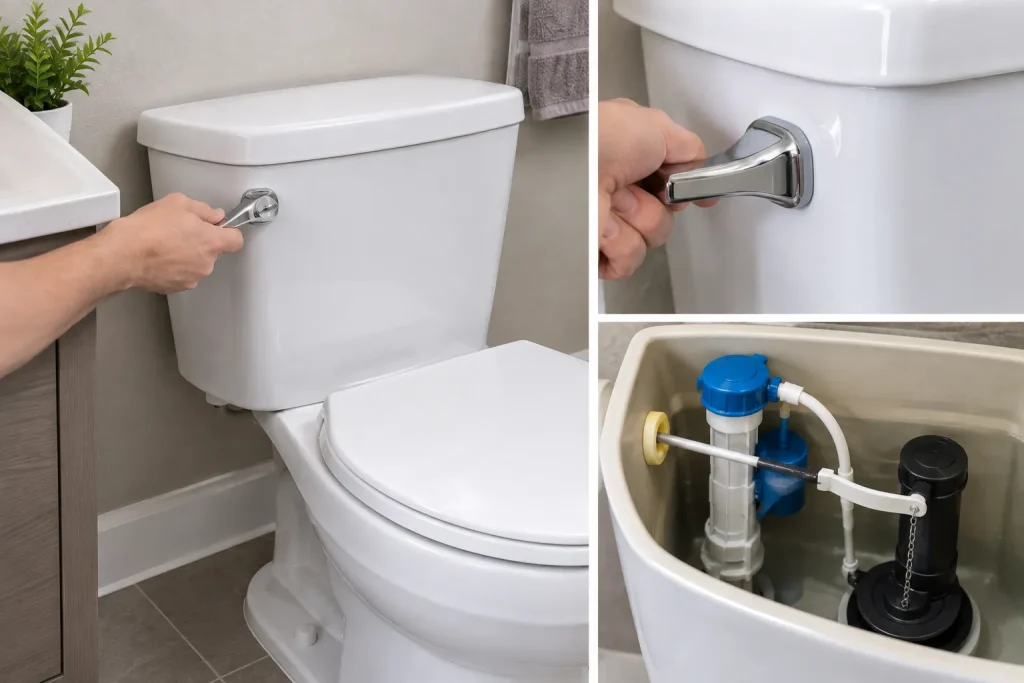
How a Toilet Handle Actually Works
A standard gravity-flush toilet uses a surprisingly simple mechanical connection.
When you press the handle, the outside lever moves inside the tank. That lift arm raises the flush valve or flapper through a chain or similar connection. Water leaves the tank and enters the bowl. Once the handle is released, the internal components should return to their normal positions.
That means there are several moving points where friction, incorrect adjustment, corrosion, or wear can cause the handle to stick.
The handle itself is only the part you can see. The real problem may be somewhere inside the tank.
1. The Handle Mounting Nut Is Too Tight
This is one of the easiest causes to overlook.
Many toilet handles are secured to the tank by a plastic or metal mounting nut from inside the tank. If that nut is tightened excessively, it can create too much friction around the handle shaft.
The result is a handle that does not spring back freely after flushing.
This often happens after a homeowner replaces a handle and assumes that tighter always means better. It does not. The handle needs to be secure while still being able to rotate or move freely.
When inspecting it, do not automatically use a wrench and tighten it further. Some toilet handle assemblies use reverse-threaded nuts, so the direction can also be different from what you might expect.
2. The Toilet Handle Is Corroded or Worn
Bathroom humidity, tank condensation, cleaning chemicals, and years of repeated use can eventually affect the handle assembly.
A metal lever may corrode. Plastic components can become brittle. The shaft may develop rough surfaces that increase friction.
If the handle feels gritty, stiff, or noticeably different from how it felt when new, replacing the complete handle assembly is often more practical than trying to make an old part work indefinitely.
3. The Lift Arm Is Bent
The internal lift arm should move through a predictable path. If it becomes bent, it may contact the inside wall of the tank or interfere with another component.
This can happen if someone pulls the handle unusually hard or if a replacement handle was installed incorrectly.
A bent arm can create an interesting symptom: the handle may feel normal during part of its movement but stick near the end of the flush.
Open the tank and watch the arm while operating the handle slowly. You are looking for side-to-side movement, contact with the tank wall, or an arm that does not return to its original position.
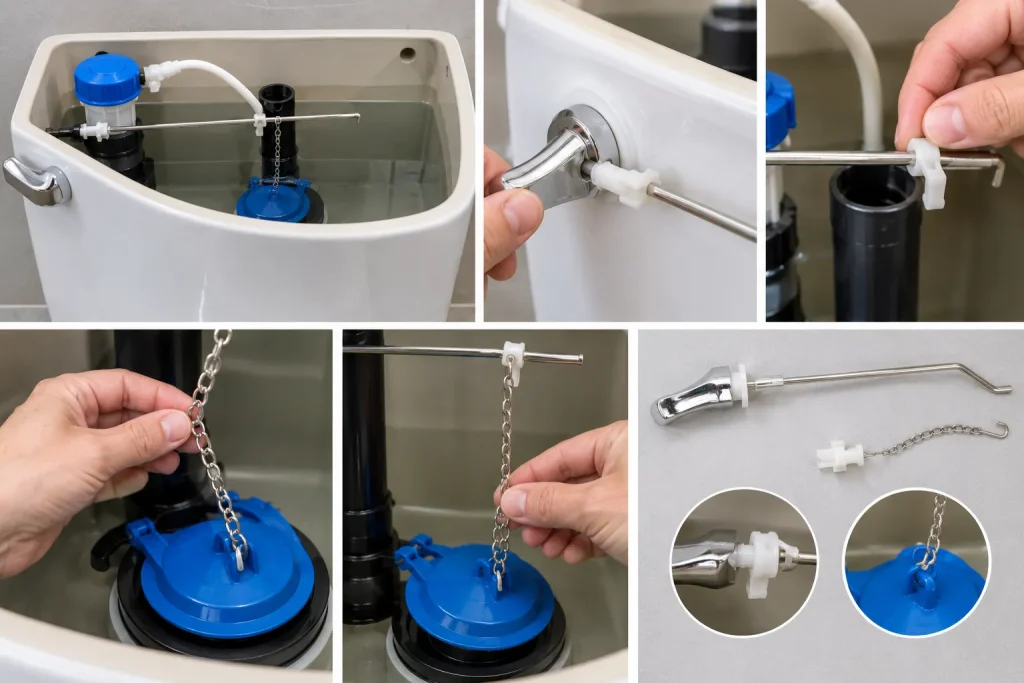
4. The Chain Has Too Little Slack
The chain between the lift arm and flush valve needs the correct amount of slack.
If the chain is too short, the handle can remain under tension after the flush begins. That tension may prevent the handle and flush valve from fully returning to their resting positions.
If the chain is excessively tight, the toilet can also continue leaking because the flush valve does not seat properly.
A small amount of free movement is normally desirable. The exact adjustment varies by toilet design, so avoid copying a chain length from another toilet without checking how your own flush mechanism works.
5. The Chain Is Tangled or Misaligned
A chain does not need to be broken to cause trouble.
It can catch around the lift arm, become wrapped around another component, or sit at an angle that makes the mechanism bind.
When the chain is misaligned, the handle may stick because the lift arm cannot return along its normal path.
This is particularly easy to diagnose because the problem is visible when the tank lid is removed.
6. The Flush Valve Is Not Returning Correctly
Sometimes homeowners blame the handle when the real problem is the flush valve.
After the flush, the flush valve or flapper should return to its seat and stop the flow of water from the tank into the bowl. If that component is sticky, distorted, mineral-encrusted, or damaged, the handle may feel unusual because it is still connected to a mechanism that is not moving correctly.
This is especially important when the toilet also makes a faint hissing sound after flushing.
If pressing the handle again or physically moving it changes the running condition, inspect the entire flush mechanism rather than replacing the external handle automatically.
7. Mineral Buildup Can Increase Friction
Hard water can leave mineral deposits on moving components inside the toilet tank.
These deposits can make a lever, pivot point, or flush valve seal less smooth over time.
Mineral buildup is more likely to become a problem when the toilet has been in service for years and the handle gradually becomes harder to operate rather than failing suddenly.
Do not assume that every stiff handle needs lubricant. Many toilet parts are plastic or rubber and may not respond well to inappropriate oils or household sprays. Cleaning or replacing the affected component is often the safer approach.
8. The Tank Is Physically Interfering With the Handle
The handle assembly needs enough clearance to operate inside the tank.
A replacement handle may technically fit the tank but have a lift arm with a different shape from the original part. That arm can hit the tank wall, fill valve, or other internal component.
This is a common reason a newly installed handle works for a short time but then begins sticking or feels awkward.
Always check the movement of the complete assembly with the tank lid removed before assuming the replacement part is defective.
How to Diagnose a Sticking Toilet Handle
You do not need to disassemble the whole toilet to perform a basic diagnosis.
Start by removing the tank lid and flushing the toilet while watching the internal mechanism.
| What You Notice | Most Likely Cause | First Action |
|---|---|---|
| Handle feels stiff even when disconnected from the chain | Handle assembly or mounting nut | Inspect mounting and replace if worn |
| Handle moves but lift arm rubs the tank | Bent or incorrect lift arm | Realign or replace handle |
| Handle stays down because the chain is tight | Incorrect chain adjustment | Add appropriate slack |
| Handle feels normal but toilet keeps running | Flush valve, flapper, or seal problem | Inspect the valve mechanism |
| Problem started after replacing the handle | Incorrect replacement or installation | Compare the new assembly with the original |
Step-by-Step: How to Fix a Toilet Handle That Sticks
Step 1: Turn Off the Water if Necessary
For a basic inspection, you usually do not need to shut off the water. However, if you are replacing the handle assembly or removing internal components, close the toilet’s shutoff valve and flush the toilet to lower the tank water level.
Step 2: Remove the Tank Lid
Place the tank lid somewhere safe. Toilet tank lids are heavy ceramic pieces and can crack if they are dropped against a hard surface.
Step 3: Operate the Handle Slowly
Press and release the handle while watching the lift arm.
Look for rubbing, bending, excessive movement, or a mechanism that remains under tension after you release the handle.
Step 4: Inspect the Chain
Make sure the chain is not twisted or wrapped around another component. Check that it is not pulling the flush valve upward after the handle has been released.
Step 5: Check the Handle Nut
Inspect the mounting nut inside the tank. If the handle is extremely stiff and the nut appears overtightened, correct the installation carefully according to the handle manufacturer’s design.
Step 6: Test the Mechanism Again
Operate the handle several times with the tank lid still removed. It should move smoothly and return consistently each time.
Do not test it once and assume the repair worked. Repeated cycling is useful because some problems only appear after several flushes.
When Should You Replace the Toilet Handle?
Replacing the handle is usually reasonable when:
- The handle is visibly cracked or corroded
- The shaft is worn
- The lift arm is bent
- The handle remains stiff after correcting installation
- The replacement part is inexpensive and readily available
A toilet handle is a relatively inexpensive component compared with many other plumbing repairs, so spending a long time trying to restore a badly worn handle often does not make practical sense.
Should You Replace the Handle or the Flush Valve?
| Problem | Better Repair | Why |
|---|---|---|
| Handle itself is stiff | Handle replacement | The external mechanism is worn or binding |
| Lift arm is bent | Handle assembly replacement | Correct geometry is needed for reliable movement |
| Chain is wrong | Adjust or replace chain | The handle may be fine |
| Flush valve sticks | Flush valve service or replacement | The handle is only reacting to the internal mechanism |
| Toilet runs after flushing | Inspect flush valve and seal | The problem may be water escaping into the bowl |
How Much Does It Cost to Fix a Sticking Toilet Handle?
The repair can range from a simple homeowner adjustment to a larger service call if the sticking handle is only one symptom of a bigger toilet problem.
| Repair | Typical Difficulty | Cost Level |
|---|---|---|
| Clean and adjust handle | Easy | Low |
| Replace toilet handle | Easy | Low |
| Replace chain | Easy | Low |
| Replace flapper or flush valve seal | Easy to moderate | Low to moderate |
| Replace complete flush valve | Moderate | Moderate |
| Professional toilet service | Depends on diagnosis | Varies by local labor rates |
Actual prices vary by toilet model, replacement parts, labor rates, and whether additional plumbing problems are discovered.
Real-World Scenario: The Handle Sticks Only in the Morning
Suppose your bathroom toilet works normally throughout the day, but the handle feels stiff during the first flush in the morning.
That pattern may point toward gradual friction in the handle mechanism rather than an immediate failure of the toilet’s drain system.
Over several flushes, the movement may temporarily feel smoother, which can make the problem easy to ignore.
I would still inspect the handle and lift arm rather than waiting for it to fail completely. A part that is already binding can eventually become stuck enough to hold the flush valve open.
Real-World Scenario: The Handle Sticks and the Toilet Keeps Running
This is more urgent because two symptoms are now connected.
If the handle remains partially depressed and the toilet continues running, the handle may be holding the flush mechanism open. The first step is to determine whether the handle itself is causing the valve to stay open or whether the flush valve is failing to seal independently.
Do not simply push the handle back every time and consider the problem solved.
A continuously running toilet can waste a significant amount of water, and the underlying component will not repair itself.
Could a Sticking Handle Be Caused by the Toilet Tank Lid?
Normally, the tank lid should not interfere with the handle mechanism, but an incorrectly positioned lid or an incompatible replacement handle can create clearance problems.
When diagnosing the issue, remove the lid and operate the handle. If the mechanism works correctly with the lid removed but sticks after the lid is installed, inspect the clearance around the handle and lift arm.
Can You Lubricate a Sticking Toilet Handle?
Lubrication is not usually the first repair I recommend.
The toilet tank contains rubber seals, plastic components, and moving parts that may not be compatible with random household oils or petroleum-based products.
If friction is caused by corrosion, mineral buildup, a damaged component, or an overtightened mounting nut, correcting the underlying cause is better than simply adding lubricant.
When a toilet handle is inexpensive and visibly worn, replacement is often more reliable than trying to lubricate it back into service.
How to Prevent a Toilet Handle From Sticking
There are a few simple habits that can extend the life of the mechanism.
- Do not pull or force the handle harder than necessary.
- Inspect the chain when the toilet is being serviced.
- Replace badly corroded or worn hardware before it fails.
- Keep the tank components properly aligned.
- Use replacement parts designed for the toilet or flush-valve assembly.
- Fix a handle that is gradually becoming stiffer instead of waiting for complete failure.
During routine toilet maintenance, operating the handle while watching the internal mechanism is a quick way to catch a developing problem.
Toilet Repair, Maintenance, and Purchase Guide
When Is a Sticking Handle a Sign of a Bigger Toilet Problem?
A sticking handle by itself is usually a small repair.
However, pay more attention when it appears together with other symptoms:
- The toilet runs continuously after flushing
- The bowl water level changes unexpectedly
- The flush is becoming weak
- The tank takes unusually long to refill
- The flush valve or flapper looks visibly damaged
- The handle has to be held down for the toilet to flush properly
These symptoms can indicate that the handle problem is only one part of a larger flush-system issue.
Frequently Asked Questions
Why does my toilet handle stick down after flushing?
The handle may stick because the mounting nut is too tight, the handle assembly is worn, the lift arm is bent, or the chain is pulling against the flush valve. A quick inspection inside the tank can usually narrow down the cause.
Why does my toilet handle not spring back?
A handle that does not spring back may have excessive friction at the mounting point or may be connected to a flush mechanism that is not returning correctly. Inspect the handle, lift arm, chain, and flush valve as one system.
Can a stuck toilet handle cause the toilet to run?
Yes. If the handle or connected lift arm keeps the flush valve open, water can continue flowing from the tank into the bowl. A worn or poorly adjusted flush mechanism can create a similar symptom even when the external handle appears normal.
How do I know whether the toilet handle or flapper is the problem?
Watch the internal mechanism with the tank lid removed. If the handle or lift arm does not return freely, focus on the handle assembly. If the handle returns normally but water continues entering the bowl, inspect the flapper or flush valve.
Is it better to repair or replace a sticking toilet handle?
If the problem is a simple adjustment, repair makes sense. If the handle is cracked, corroded, bent, or repeatedly sticking, replacing the handle assembly is usually the more dependable solution.
Conclusion
A toilet handle that sticks after flushing is usually not a serious plumbing emergency, but it should not be ignored indefinitely.
The most common causes are surprisingly basic: an overtightened mounting nut, a worn handle, a bent lift arm, an improperly adjusted chain, or a flush valve that does not return correctly.
The best way to diagnose the problem is to remove the tank lid and watch the entire mechanism while pressing and releasing the handle. That tells you much more than simply looking at the handle from the outside.
If the handle itself is worn or damaged, replacing the assembly is usually the simplest repair. If the handle moves normally but the toilet continues running, investigate the flush valve or flapper instead.
Taking care of the problem early is inexpensive and can prevent a minor mechanical issue from turning into a continuously running toilet or a more frustrating repair.