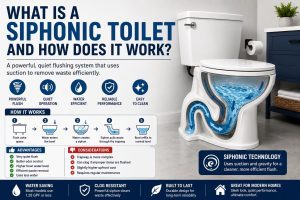
Dual-flush toilets have become much more common in American bathroom remodeling projects, but that does not automatically mean they are the best choice for every home.
The idea is simple: use a smaller flush for liquid waste and a stronger full flush for solid waste. In the right household, this can reduce unnecessary water use without making everyday toilet use complicated. But there are also practical questions about flushing performance, replacement parts, maintenance, installation, and whether everyone in the family will actually use the two flush options correctly.
For a homeowner replacing a toilet, the better question is not simply, “Are dual-flush toilets good?” It is, “Does a dual-flush toilet make sense for the way my household actually uses the bathroom?”
This guide looks at that decision from a practical American homeowner’s perspective.
Quick Answer: Are Dual-Flush Toilets Worth It?
Yes, a dual-flush toilet can be an excellent choice for an American home, especially when water efficiency is important and the household is comfortable using the two flush settings.
However, the dual-flush mechanism itself should not be the deciding factor. A well-designed single-flush WaterSense toilet can also provide excellent efficiency and flushing performance.
A dual-flush toilet is usually a strong fit for:
- Homes where several people use the bathroom every day
- Households trying to reduce unnecessary toilet water use
- Bathroom remodels where a modern toilet design is desired
- Homeowners who are willing to choose the correct flush mode for each use
- Families replacing older, inefficient toilets
A single-flush toilet may be more practical for:
- Rental properties with frequent tenant turnover
- Homes where users may ignore the two-button system
- Bathrooms where maximum simplicity is the priority
- Homeowners who want the easiest possible repair process
The biggest advantage is not that every flush uses less water. The advantage is that the toilet gives you more control over how much water is used for different jobs.
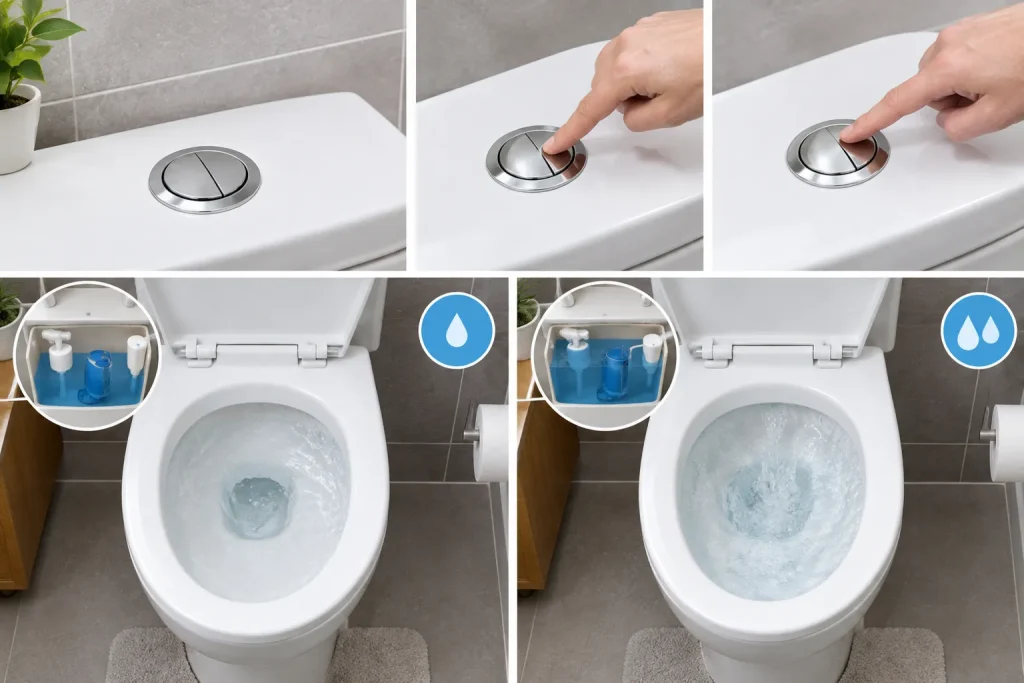
How Does a Dual-Flush Toilet Work?
A typical dual-flush toilet uses two flush options. One is designed for a reduced flush, while the other provides a full flush.
The exact flush volumes vary by model. Some toilets may use a relatively small volume for the reduced flush and a larger amount for solid waste. This means you should not assume that every dual-flush toilet saves the same amount of water.
The flushing mechanism can also differ between models. Some use a top-mounted two-button actuator, while others use a side control or integrated electronic control.
From a homeowner’s perspective, the important point is straightforward: the toilet gives you two different flush choices instead of forcing every flush to use the same amount of water.
Why Water Efficiency Matters in an American Home
Toilets are one of the largest sources of indoor residential water use. The EPA estimates that toilets account for nearly 30 percent of indoor water consumption in an average home. Older toilets can use substantially more water per flush than modern high-efficiency models.
EPA WaterSense-labeled toilets use 1.28 gallons per flush or less, compared with the current federal maximum of 1.6 gallons per flush for standard tank-type toilets. EPA also states that replacing old, inefficient toilets with WaterSense-labeled models can reduce toilet water use by 20% to 60%, depending on what is being replaced and how the new toilet is used.
That does not mean every dual-flush toilet automatically saves the maximum possible amount of water. Household behavior matters.
For example, imagine a four-person household that uses a bathroom frequently. If family members consistently use the reduced flush for liquid waste, the household may avoid using the full flush when it is unnecessary.
On the other hand, if everyone simply presses the larger-flush button every time, much of the theoretical advantage disappears.
Dual-Flush vs Single-Flush Toilets
| Feature | Dual-Flush Toilet | Single-Flush Toilet |
|---|---|---|
| Flush choices | Reduced and full flush | One flush volume |
| Water efficiency | Can reduce water use when the reduced setting is used correctly | Modern WaterSense models can also be highly efficient |
| User simplicity | Requires choosing the correct button or setting | Very simple operation |
| Maintenance | More control components can mean additional parts to inspect | Usually simpler mechanically |
| Design | Often has a modern appearance | Available in traditional and modern styles |
| Best for | Water-conscious households | Homeowners prioritizing simplicity |
There is an important practical lesson here: dual-flush does not automatically mean better flushing, lower maintenance, or lower lifetime cost.
The quality of the bowl design, trapway, flush valve, fill valve, and overall engineering still matters.
Advantages of a Dual-Flush Toilet
1. Better Control Over Water Use
The biggest benefit is control. A homeowner does not need to use a full flush for every bathroom visit.
This is especially useful in a busy household where a significant number of toilet uses involve liquid waste only.
2. Good Fit for Water-Conscious Homes
For homeowners actively trying to reduce household water consumption, the two-flush system is intuitive once everyone understands it.
This can be particularly attractive during a bathroom remodel when the goal is to combine modern fixtures with lower resource consumption.
3. Modern Design Options
Many dual-flush toilets are designed with contemporary bathrooms in mind. Two-button controls can look cleaner than traditional handle-based designs, particularly with concealed or minimalist bathroom layouts.
4. Useful in Frequently Used Bathrooms
A half bath, guest bathroom, primary bathroom, or family bathroom can all benefit from water-use flexibility. The more often the toilet is used, the more meaningful correct flush selection can become.
Disadvantages of a Dual-Flush Toilet
1. More Parts to Understand
A dual-flush toilet may have a more specialized flush valve or actuator assembly than a basic single-flush toilet.
That does not make the toilet unreliable by definition, but it does mean homeowners should pay attention to replacement-part availability before buying.
2. Users Can Choose the Wrong Flush
This is one of the most common practical problems.
Some family members may always use the full flush because it feels safer. Guests may not understand which button performs which function. Children may simply push both buttons or use the larger setting every time.
When that happens, the household may use more water than expected.
3. Repairs Can Be Less Familiar
A homeowner who is comfortable replacing a traditional flapper may be less familiar with a dual-flush button assembly, seal, or flush valve cartridge.
Replacement parts are usually available for established brands, but you still need to identify the correct model or valve system.
4. Some Budget Models Prioritize Features Over Refinement
Price alone does not tell you whether a dual-flush toilet is good. A poorly engineered low-cost model can have an awkward actuator, inconsistent flushing, difficult-to-source parts, or an uncomfortable bowl design.
For a toilet, dependable performance is more important than having the most features for the lowest price.
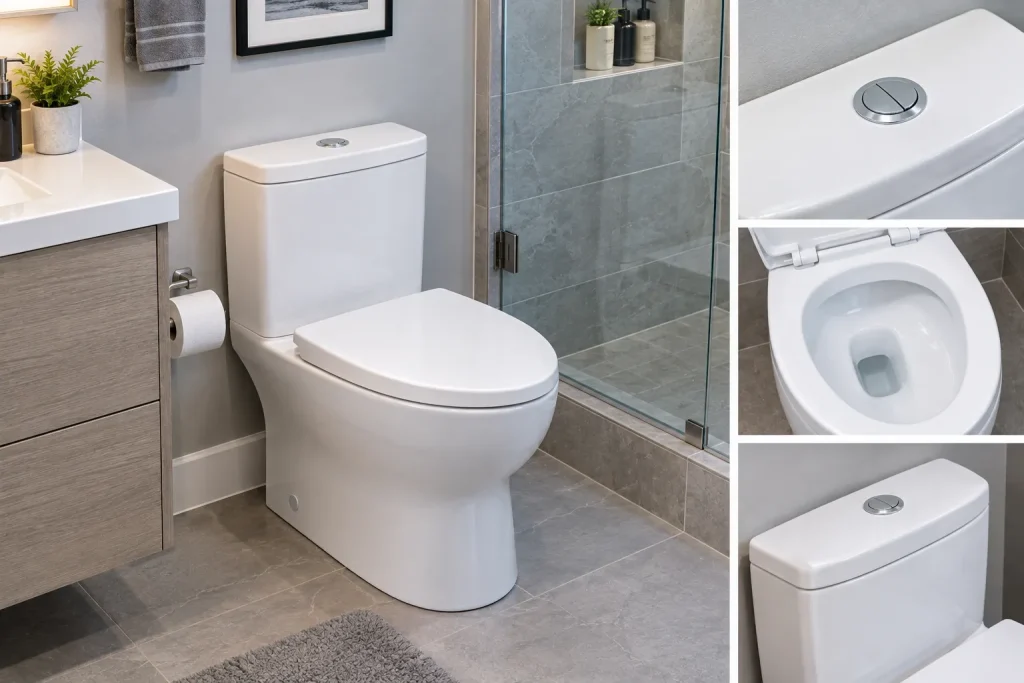
How Much Does a Dual-Flush Toilet Cost?
The purchase price depends heavily on the brand, bowl design, flushing technology, height, finish, and whether the toilet is sold as a complete package with seat and tank components.
| Cost Area | Typical Homeowner Consideration |
|---|---|
| Toilet purchase | Entry-level models can be relatively affordable, while premium designs can cost several hundred dollars or more |
| Installation | Basic replacement is often less expensive than relocating plumbing or repairing the flange |
| Removal | Old toilet removal may add labor or disposal costs |
| Additional parts | Supply line, wax ring or approved sealing system, shutoff valve, or flange repair may add cost |
| Future maintenance | Replacement seals, valves, actuators, and other trim parts should be considered |
Actual labor and plumbing costs vary by region, toilet condition, and the amount of repair required. A straightforward toilet swap is a very different job from replacing a toilet with a damaged flange or changing the plumbing layout.
Does a Dual-Flush Toilet Save Enough Water to Matter?
It can, but the answer depends on usage.
Consider two households.
Household A: Four people use the toilet frequently. Family members consistently use the reduced flush for liquid waste and reserve the full flush for solid waste.
Household B: Two people use the toilet less often, but both usually use the full flush because they do not want to think about which button to press.
Household A is more likely to capture the real-world water-saving benefit of the dual-flush design.
This is why comparing toilets only by advertised flush modes can be misleading. Actual household behavior is part of the efficiency equation.
For reference, EPA’s WaterSense guidance uses household toilet-use assumptions when estimating water savings, and notes that actual savings can vary from predicted results.
Are Dual-Flush Toilets Harder to Maintain?
Not necessarily.
The ceramic bowl and tank still require the same basic care as other toilets: cleaning, checking for leaks, keeping the flush path clear, and replacing worn seals or valves when needed.
The main difference is the control system.
For example, if the toilet develops a weak reduced flush but the full flush still works normally, the problem may be related to the dual-flush valve, actuator, seal, or adjustment rather than the drain itself.
That makes diagnosis slightly different from a traditional single-flush toilet.
A good maintenance habit is to occasionally check:
- Whether either button sticks or feels unusually loose
- Whether the toilet continues running after flushing
- Whether water is leaking into the bowl continuously
- Whether the reduced flush still provides adequate bowl cleaning
- Whether replacement parts are beginning to show wear
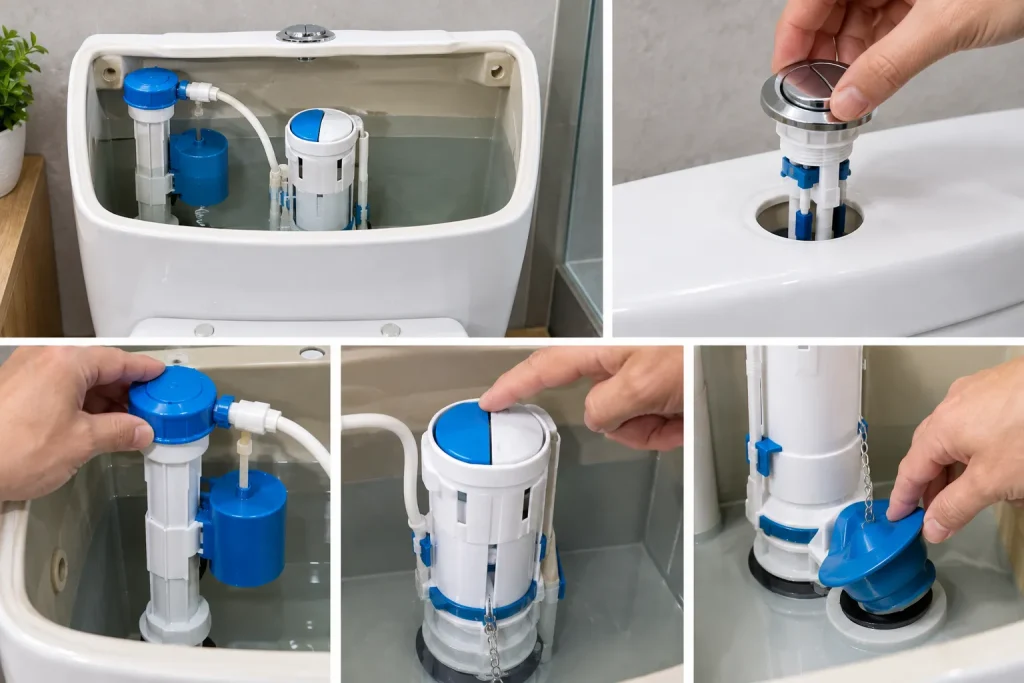
Real-World Scenario: When a Dual-Flush Toilet Makes Sense
Imagine a family of four with a frequently used upstairs bathroom.
The bathroom is used every morning before school and work, again after everyone returns home, and throughout the evening. Many of the bathroom visits do not require the full amount of water.
In this situation, a dual-flush toilet makes practical sense because the household has both frequent usage and a genuine opportunity to choose a smaller flush.
Now consider a small guest bathroom in a home that is mostly occupied by two adults. If simplicity is more important than reducing every possible gallon of water, a high-quality single-flush WaterSense toilet may be the easier choice.
The lesson is simple: choose the flushing system according to the bathroom’s usage pattern, not just the marketing label on the box.
What Should You Check Before Buying a Dual-Flush Toilet?
Before purchasing, look beyond the two-button design.
Check the Rough-In
Measure the existing toilet’s rough-in before buying a replacement. A toilet that does not fit the existing plumbing location can turn a simple replacement into a more expensive installation project.
Check the Bowl Shape and Bathroom Clearance
Round and elongated bowls can have different space requirements. In a small bathroom, the wrong bowl shape may reduce usable floor space or make the door clearance awkward.
Check the Flush Performance
Do not assume that a dual-flush toilet will have strong flushing performance simply because it has a full-flush button. Look for a reputable model with verified performance testing and appropriate certification.
Look for WaterSense When Efficiency Is a Priority
The WaterSense label is useful because it combines water-efficiency criteria with independent certification and performance requirements. EPA states that WaterSense-labeled tank-type toilets use 1.28 gallons per flush or less.
That gives homeowners a more useful benchmark than simply choosing a toilet because the package says “dual flush.”
Check Replacement Parts
Before buying an unfamiliar model, search for replacement flush valves, seals, buttons, fill valves, and other service parts. A toilet can look excellent on installation day but become frustrating several years later if basic repair components are difficult to source.
Toilet Repair, Maintenance, and Purchase Guide
Is a Dual-Flush Toilet Better for a Rental Property?
Usually, I would be more cautious with rental properties.
A rental toilet needs to be easy for different users to understand and easy for maintenance staff or plumbers to service.
A dual-flush toilet can still work very well in a rental, but I would prioritize:
- A widely supported brand
- Readily available replacement parts
- A simple two-button control
- Reliable flushing performance
- Good long-term serviceability
For a landlord, the small water-saving advantage may be less important than avoiding a specialized repair problem during a tenant turnover.
Is a Dual-Flush Toilet Good for an Older American Home?
It can be, but the condition of the existing plumbing matters.
If the home has an older toilet, replacing it with a modern efficient model can be a meaningful upgrade. EPA notes that older toilets can use substantially more water than modern WaterSense-labeled models.
At the same time, do not assume that replacing the toilet alone will solve every flushing problem.
If the house has recurring drain restrictions, poor venting, damaged plumbing, or a problematic flange, installing a new toilet may not eliminate the underlying issue.
Who Should Buy a Dual-Flush Toilet?
| Homeowner Situation | Recommendation |
|---|---|
| Large family with frequent bathroom use | Good choice |
| Homeowner focused on water efficiency | Good choice |
| Modern bathroom remodel | Good choice |
| Small bathroom | Good choice if size and rough-in fit |
| Rental property | Choose carefully |
| Homeowner who wants the simplest mechanism possible | Single-flush may be better |
| Older home with plumbing problems | Inspect plumbing first |
Frequently Asked Questions
Are dual-flush toilets worth it in the USA?
Yes, they can be worth it, particularly for households that use the reduced flush correctly and want better control over toilet water consumption. A high-quality WaterSense single-flush toilet can also be an excellent alternative.
Do dual-flush toilets use less water?
They can use less water because the reduced-flush option avoids using the full flush when it is unnecessary. Actual household savings depend on the toilet model and how consistently users select the reduced setting.
Are dual-flush toilets reliable?
Good-quality models can be reliable, but reliability depends on the flush valve, seals, actuator, fill valve, installation quality, and replacement-part availability. A dual-flush mechanism is not automatically more or less reliable simply because it has two flush options.
Are dual-flush toilets harder to repair?
Some repairs may be slightly less familiar than those on basic single-flush toilets, especially when the flush valve or actuator needs replacement. However, routine maintenance is generally straightforward when replacement parts are readily available.
Should I choose a dual-flush or single-flush toilet for my bathroom?
Choose dual-flush when water efficiency and flexible flushing are important and the household is willing to use the two settings correctly. Choose single-flush when simplicity, familiarity, and straightforward maintenance are the top priorities.
Conclusion
So, are dual-flush toilets a good choice for an American home?
For many homeowners, yes.
The strongest reason to buy one is not simply the two-button design. It is the ability to match water use to the job being done. In a busy household, that flexibility can make practical sense.
But a dual-flush toilet is not automatically superior to a single-flush toilet. Bowl design, flushing performance, water efficiency, installation fit, repair parts, and long-term serviceability still matter.
For most American homeowners replacing an old toilet today, a good starting point is to look for a properly sized, well-reviewed, WaterSense-labeled model from a manufacturer with readily available replacement parts. From there, decide whether the dual-flush mechanism actually fits the way your household uses the bathroom.
In other words, buy the toilet that fits your home and habits, not just the toilet with the most features.