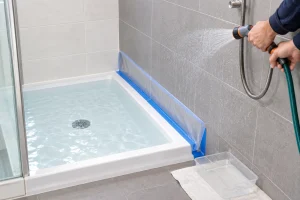
Tile can make a bathroom look completely waterproof. The surface is hard, easy to clean, and most porcelain or ceramic tiles absorb very little water. But there is an important difference between a tile surface that resists water and a bathroom assembly that is actually waterproof.
That difference matters most in showers, around tubs, at floor-to-wall transitions, and anywhere water can sit or repeatedly enter joints.
If you have ever found a soft spot in the bathroom wall, swollen trim, stained drywall in the room below, or a musty smell behind a shower wall, the problem usually is not that the tile suddenly became “too wet.” The problem is that water found a path past the finished surface and the underlying waterproofing system was missing, damaged, or improperly installed.
The quick answer: water-resistant tile helps keep water from penetrating the finished surface, but tile itself should not be treated as the primary waterproofing layer. In a properly built wet area, the waterproofing system behind or beneath the tile is what provides the critical barrier against leakage.
What Is the Difference Between Water-Resistant Tile and Bathroom Waterproofing?
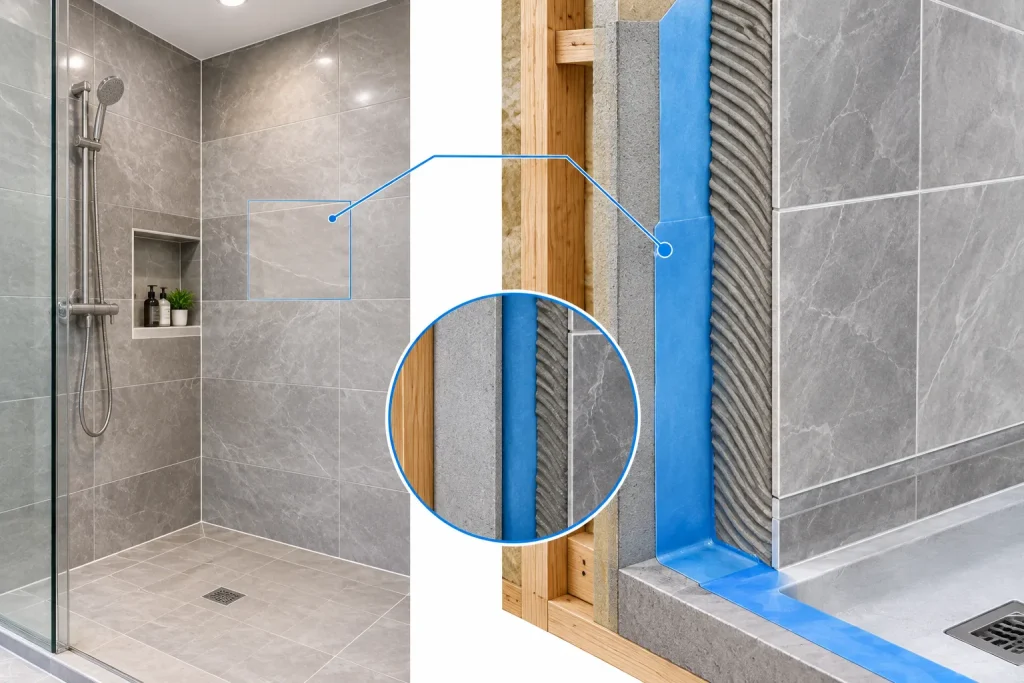
Think of a tiled shower as a layered system rather than a single waterproof surface.
The tile is the finish you see and touch. Grout fills many of the joints between tiles. Behind that finish may be a bonded sheet membrane, liquid-applied membrane, waterproof backer system, traditional shower pan liner, or another approved assembly designed for the specific installation.
Tile and grout can shed a large amount of surface water, but joints, corners, penetrations, movement, installation defects, and cracks can allow moisture to move farther into the assembly.
Water-resistant tile: designed to resist water absorption and perform well as a finished bathroom surface.
Waterproofing: a continuous system intended to keep water from reaching moisture-sensitive materials and structural components.
This distinction is why replacing cracked grout or installing a new tile surface does not automatically solve a shower leak.
Does Porcelain Tile Make a Shower Waterproof?
No. Porcelain tile can be highly water-resistant, but the tile itself does not make the entire shower waterproof.
Even when a tile has very low water absorption, the shower contains dozens of other potential paths for moisture. These include grout joints, inside corners, movement joints, plumbing penetrations, valve openings, niches, benches, shower doors, curb transitions, and the drain connection.
There is also a practical issue: water does not always stay exactly where you can see it. A small amount of moisture can move behind a finish over time and cause damage if the assembly does not provide a reliable drainage and waterproofing strategy.
That is why a high-quality porcelain tile installed over a poorly waterproofed shower can still result in a very expensive repair.
What Actually Prevents Bathroom Leaks?
The most important protection is a properly designed and correctly installed waterproofing system.
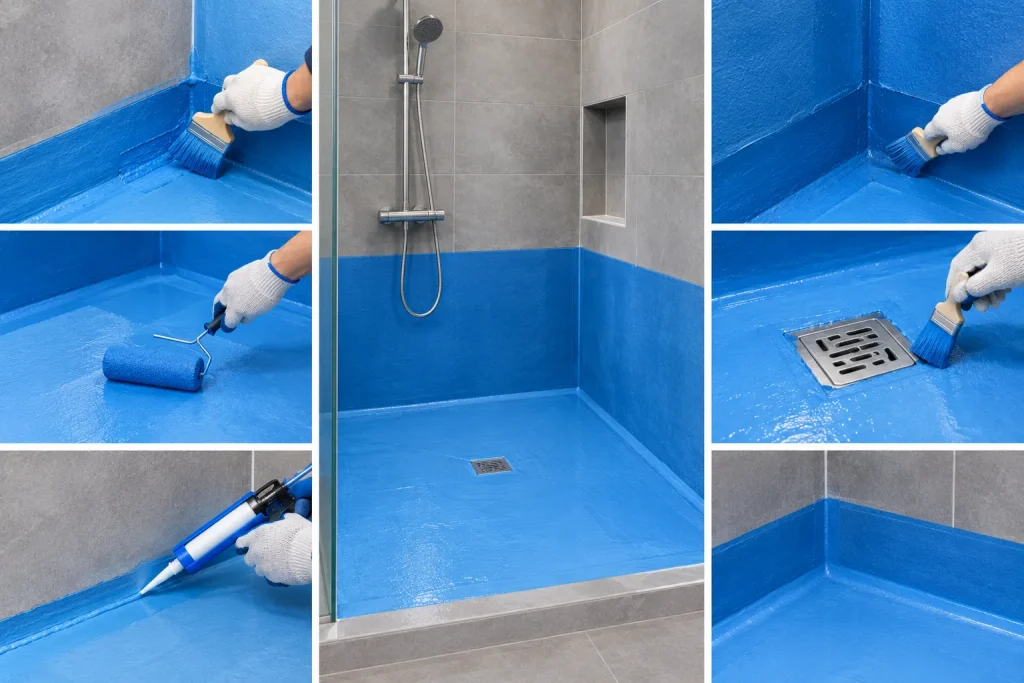
In a shower, that system needs to address more than the flat wall or floor. It must deal with transitions, corners, penetrations, seams, the drain, and other locations where different materials meet.
ANSI A118.10, the current standard for load-bearing bonded waterproof membranes used with thin-set ceramic tile and dimension stone installations, specifically addresses waterproof membrane performance. That is very different from simply choosing a tile with low water absorption.
For shower floors, the plumbing code also treats the shower receptor as a watertight assembly. The 2024 International Plumbing Code requires shower floors or receptors to use waterproof materials and requires the area beneath the shower to be lined and made watertight, with specific provisions for liners, slopes, drains, and testing.
In other words, the tile is part of the finished surface. The waterproofing system is part of the leak-prevention system.
Why Grout Is Not a Waterproofing System
This is one of the most common misunderstandings in bathroom renovation.
People often say, “My grout is waterproof, so water can’t get behind the tile.” In practice, that is not a reliable way to think about a shower.
Grout can help reduce direct water penetration and can provide a durable joint between tiles, but grout should not be treated as a substitute for a properly detailed waterproofing assembly.
Even a well-maintained grout joint can experience hairline cracks, movement-related cracking, staining, deterioration, or separation. Cement-based grout can also absorb some moisture.
The correct question is not, “Is my grout waterproof?”
The better question is, “What happens if some water gets past the grout?”
A well-designed shower has an answer to that question.
Where Bathroom Waterproofing Usually Fails
Most shower waterproofing failures are not caused by water simply passing through the middle of an intact tile. They are often associated with details where components meet or where penetrations interrupt the waterproofing layer.
- Inside corners: Corners need continuous waterproofing and properly treated seams.
- Wall-to-floor transitions: This area sees movement and constant exposure to splash water.
- Shower drains: The waterproofing layer must connect to the drain assembly correctly.
- Plumbing penetrations: Shower valves, pipes, and other penetrations create openings that require proper sealing.
- Shower niches: A poorly sloped or poorly waterproofed niche can trap water.
- Curbs: Curbs are especially vulnerable when waterproofing is punctured by fasteners or improperly connected at corners.
- Benches: Horizontal surfaces need appropriate slope and continuous waterproofing.
- Membrane seams: Improperly overlapped, bonded, or sealed seams can create hidden leak paths.
Building-code requirements similarly emphasize watertight treatment of shower liners, drains, joints, and penetrations rather than relying on the visible finish alone.
Waterproofing Behind Tile vs Waterproof Tile Surface
Imagine two showers that look identical after the renovation.
Both use attractive porcelain tile. Both have clean grout lines. Both look completely finished.
In Shower A, the installer used a properly specified waterproofing system and carefully treated seams, corners, penetrations, and the drain connection.
In Shower B, the installer concentrated heavily on the tile installation but used an incomplete or poorly detailed moisture barrier.
For the first few months, you might not notice any difference.
After several years of daily showers, however, the difference can become very expensive.
Shower A has a dedicated layer designed to prevent water from reaching sensitive materials.
Shower B may allow repeated moisture exposure to the backing materials, framing, insulation, or adjacent rooms.
The tile finish can look almost identical while the waterproofing performance underneath is completely different.
Real-World Example: Why a Shower Wall Can Leak Without Obvious Damage
Consider a typical second-floor bathroom in a wood-framed house.
The homeowner notices a small brown stain on the ceiling directly below the shower. The shower tile looks fine. The grout appears intact. There are no obvious cracked tiles.
It is tempting to assume the ceiling stain must be caused by a plumbing pipe.
Sometimes it is. But repeated water exposure at a shower corner, curb, niche, plumbing penetration, or floor transition can also allow moisture to migrate into the wall or floor assembly.
The visible tile may remain attractive long after damage has started behind it.
This is one reason waterproofing is so important: the most serious moisture problems are not necessarily visible from the finished side.
How Much Does Bathroom Waterproofing Cost Compared With Tile?
For most bathroom renovations, waterproofing represents only part of the overall shower construction cost, but it is a poor place to cut corners.
The exact price varies widely depending on the shower size, membrane system, labor rates, substrate condition, drain configuration, niche or bench details, tile format, and whether the project involves demolition.
Large-format tile, multiple niches, curbless entries, heated floors, custom benches, and complicated transitions can increase installation labor considerably.
There is also an important economic difference between waterproofing and tile.
Tile is relatively accessible after installation. You can replace a damaged tile without rebuilding the entire bathroom.
Waterproofing is hidden. If the membrane or shower pan fails after the tile is installed, repair can require removing tile, backer materials, fixtures, or other finished components.
That is why spending more during the waterproofing stage can be much cheaper than correcting a concealed leak later.
Installation Quality Matters More Than the Brand of Tile
Homeowners sometimes spend a lot of time comparing porcelain brands while spending very little time asking how the shower will be waterproofed.
That priority can be backwards.
A premium tile installed over a poorly constructed shower assembly is still a poorly protected shower.
During a renovation, I would rather see a contractor clearly explain the waterproofing system, transitions, drain connection, substrate preparation, and testing process than simply hear that the project will use expensive tile.
One useful question to ask before installation is:
“Can you show me exactly where the waterproofing layer is, and how it connects at the corners, shower drain, curb, niche, and plumbing penetrations?”
A competent installer should be able to explain the assembly without treating waterproofing as a mysterious step hidden behind the tile.
What About Water-Resistant Backer Board?
Water-resistant or moisture-resistant building products can be useful components of a bathroom assembly, but they should not automatically be interpreted as a complete waterproofing system.
The type of backer material, its installation method, and the waterproofing strategy need to work together.
Current building-code provisions for shower and tub areas specify acceptable tile backing materials and require installation according to the applicable requirements and manufacturer instructions.
This is important because “water-resistant” and “waterproof” are not interchangeable terms.
A material can tolerate moisture better than standard drywall without being the continuous waterproof barrier that protects the wall assembly from shower water.
When Should You Use a Waterproofing Membrane?
For a regularly used shower, especially a full-height tiled shower, a dedicated waterproofing strategy is the safer approach.
It becomes particularly important when the design includes:
- Large-format wall tile
- Curbless shower floors
- Linear drains
- Built-in shower benches
- Recessed niches
- Multiple shower heads
- Steam shower conditions
- Wood-framed construction
- Bathrooms located above finished living spaces
Complex designs create more transitions and more opportunities for installation errors, which makes the continuity of the waterproofing layer even more important.
Real-World Recommendation: Which Approach Fits Your Bathroom?
For a tub surround used occasionally: Follow the approved assembly for the specific wall system and tile installation method. Do not assume the tile alone provides waterproofing.
For a standard daily-use shower: Prioritize a complete waterproofing system before spending extra money on premium tile.
For a curbless shower: Pay particular attention to the shower floor, drain transition, slope, doorway, and surrounding bathroom floor. A curbless design leaves less room for poor detailing because water can move more easily toward the rest of the bathroom.
For a second-floor shower: Waterproofing deserves extra attention because a concealed leak can damage the ceiling, insulation, framing, flooring, and finishes below.
For a shower with a niche and bench: Treat every horizontal surface, corner, and penetration as part of the waterproofing design rather than adding waterproofing as an afterthought.
How to Inspect a New Shower Before the Tile Goes In
If you are supervising a bathroom renovation, one of the best times to inspect the waterproofing is before the tile hides it.
- Look for continuous waterproofing at corners and transitions.
- Check that membrane seams are treated according to the manufacturer’s system.
- Inspect pipe and valve penetrations.
- Look closely at the shower drain connection.
- Check that benches and niches are properly integrated into the waterproofing system.
- Verify that horizontal surfaces have the required slope toward the drain.
- Ask how the shower receptor or waterproofing assembly will be tested.
Where local requirements call for shower receptor testing, the test should be completed before the assembly is concealed by tile. The 2024 IPC, for example, specifies testing provisions for shower liner assemblies.
This inspection is much easier before the tile is installed than after a leak appears six months later.
Can You Fix a Shower Leak by Regrouting?
Sometimes regrouting or replacing damaged grout is appropriate for a localized finish problem. But it should not be considered a universal shower waterproofing repair.
If water is already reaching the substrate because the underlying waterproofing system was never installed correctly or has failed, new grout only treats the visible surface.
In that situation, the repair may require removing enough tile and surrounding materials to locate the actual failure.
This is why repeatedly regrouting a shower that keeps leaking can become an expensive cycle.
The correct repair depends on where the water is entering and whether the concealed waterproofing system remains intact.
Bathroom Waterproofing vs Water-Resistant Tile: The Practical Choice
The easiest way to remember the difference is this:
- Tile controls the finished surface.
- Grout fills the joints between tiles.
- Waterproofing protects the assembly behind the finish.
- Drainage directs water toward the drain instead of trapping it.
Good bathroom construction uses these components together rather than expecting one material to do every job.
That is especially important because water-resistant tile can be extremely durable while still being only one part of the moisture-management system.
Frequently Asked Questions
Is bathroom tile waterproof?
Most quality porcelain and many ceramic tiles are highly resistant to water, but the tiled surface should not be treated as the complete waterproofing system. The joints, corners, penetrations, substrate, and drainage details still matter.
Does grout need waterproofing behind it?
In a continuously wet shower area, the safer construction approach is to use an appropriate waterproofing system behind or beneath the tile rather than relying on grout to prevent every possible path for moisture.
Can a shower leak even if the tiles are not cracked?
Yes. Leaks can occur at seams, corners, drains, plumbing penetrations, niches, curbs, benches, movement joints, or other concealed details without producing an obvious cracked tile.
Is waterproof tile enough for a bathroom floor?
No material should be selected in isolation. A bathroom floor needs an appropriate surface, substrate, drainage strategy, and waterproofing or moisture-management assembly based on the location and intended use.
Is a waterproofing membrane worth the extra cost?
For a frequently used tiled shower, especially one above finished living space or with complicated features, a properly installed waterproofing system is generally a much better investment than relying on the tile finish alone.
Conclusion
Water-resistant tile helps keep water off the visible surface, but waterproofing is what protects the bathroom assembly from leaks.
That distinction becomes critical when building or remodeling a shower. Porcelain tile, ceramic tile, grout, backer materials, membranes, drains, slopes, and sealed transitions all have different jobs.
If the goal is simply to make a bathroom look good, tile may seem like the main decision. If the goal is to keep the bathroom dry for years, the hidden waterproofing details deserve at least as much attention as the tile you can see.
When choosing a contractor, ask what waterproofing system will be used, how the seams and penetrations will be treated, how the drain will connect to the waterproofing layer, and how the shower will be tested before it is covered.
In a properly built shower, the tile is the finish. The waterproofing system is the protection.
For more expert resources, explore our Bathroom Waterproofing category, where we cover materials, repair methods, and prevention strategies in depth.