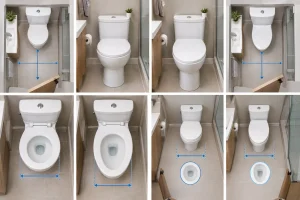
When you’re choosing a toilet for a small bathroom, the difference between a round toilet and an elongated toilet can matter more than you might expect. A few inches of extra depth can determine whether the bathroom feels comfortable or cramped, especially in a half bath, powder room, or narrow guest bathroom.
I’ve worked on plenty of bathroom layouts where the toilet looked fine on paper but felt completely different after installation. The problem was often not the toilet’s height or flushing performance—it was the amount of floor space the bowl occupied in front of the wall.
So, is a round or elongated toilet better for a small bathroom?
Quick conclusion: For a genuinely tight bathroom, a round-front toilet is usually the safer space-saving choice. An elongated toilet can still work well if the room has enough front clearance and you prefer its larger seating area. The key is to measure the actual toilet projection and available clearance rather than choosing based on bowl shape alone.
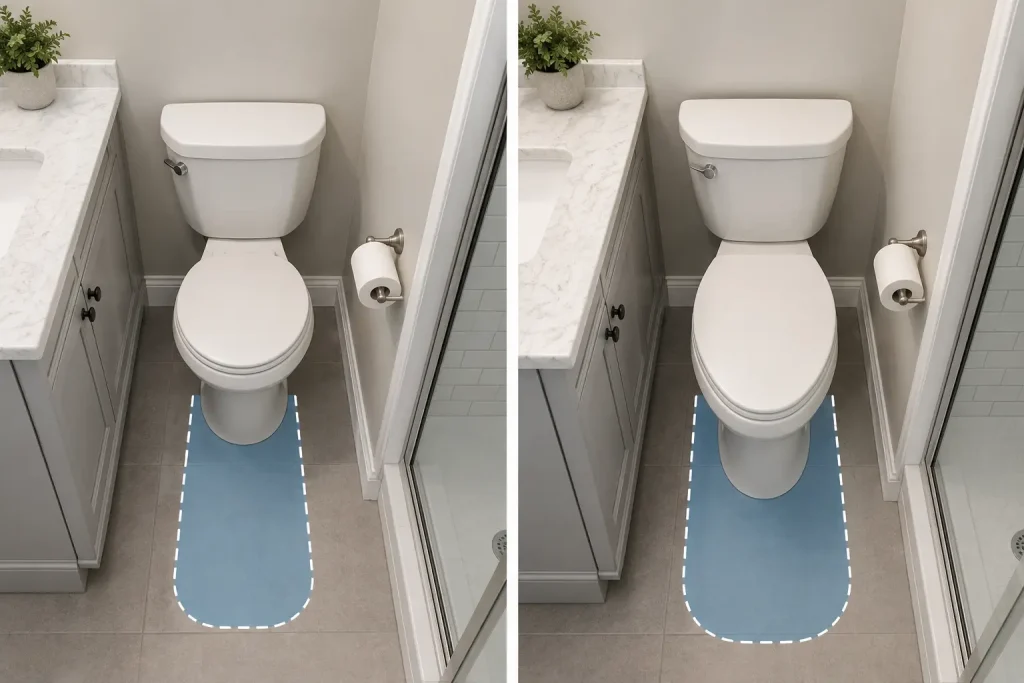
Round vs. Elongated Toilet: What Is the Difference?
The easiest way to understand the difference is to look at the shape of the bowl from above.
A round toilet has a shorter, more compact bowl that generally takes up less space from the wall toward the front of the bathroom.
An elongated toilet has a longer oval-shaped bowl. It typically provides more sitting surface, but the extra length can take up several more inches of floor space.
Neither shape is automatically “better.” They simply prioritize different things.
| Feature | Round toilet | Elongated toilet |
|---|---|---|
| Bowl shape | More compact and circular | Longer oval shape |
| Floor projection | Usually shorter | Usually longer |
| Small bathroom suitability | Excellent | Good if clearance allows |
| Seating area | Smaller | Generally larger |
| Comfort | Good for many users | Often preferred by adults |
| Cleaning | Simple bowl shape | Similar routine maintenance |
| Price | Often available at lower prices | Available across a wide price range |
| Best use | Small bathrooms and compact layouts | Larger bathrooms and comfort-focused layouts |
How Much Space Does a Round Toilet Save?
This is where the decision becomes practical.
The exact dimensions vary by manufacturer and model, so don’t assume every round toilet is automatically short. However, a typical elongated toilet can project farther into the room than a comparable round-front model.
Depending on the specific models you’re comparing, the difference can be roughly 2 inches or more of front-to-back projection.
Two inches may sound insignificant when you’re looking at a floor plan. In a small bathroom, it isn’t.
Imagine a narrow bathroom where the toilet sits directly opposite a vanity. If the toilet projects an extra couple of inches into the walking path, that can make the space feel noticeably tighter when you’re standing at the sink or opening the bathroom door.
That’s why I recommend measuring the finished toilet projection, not simply choosing “round” or “elongated” from a catalog.
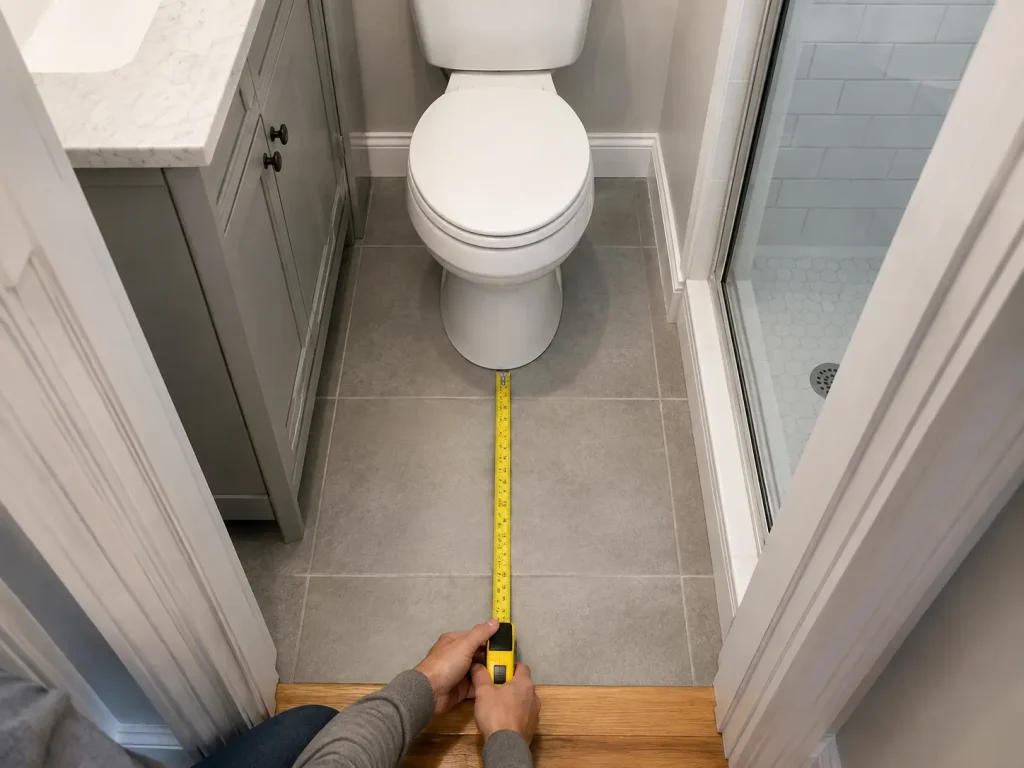
What Is the Minimum Space You Need Around a Toilet?
Toilet dimensions should always be checked against local plumbing and building requirements, but there are common planning dimensions worth knowing.
In the United States, the International Residential Code commonly requires a minimum of 21 inches of clear space in front of the toilet. A minimum of 15 inches from the toilet centerline to each side wall or obstruction is also commonly used for residential planning. Local jurisdictions can have additional requirements, so always verify the rules that apply to your project.
These clearances are important because a toilet can physically fit into a room while still making the room uncomfortable or failing the applicable code requirements.
For a small bathroom, I would think about three separate measurements:
- Toilet projection: How far the toilet extends into the room.
- Front clearance: How much usable space remains in front of the bowl.
- Side clearance: How much room remains between the toilet and nearby walls, cabinets, or fixtures.
Don’t judge the layout by the bowl alone. The tank can also affect the total depth, particularly with larger two-piece toilets.
Why Round Toilets Are Often Better for Small Bathrooms
They Take Up Less Front-to-Back Space
This is the biggest advantage.
A round-front bowl generally keeps the front of the toilet closer to the wall, leaving more open floor space in front of it.
That can be particularly useful in:
- Small powder rooms
- Half bathrooms
- Narrow guest bathrooms
- Small apartment bathrooms
- Bathrooms where the toilet faces a vanity
- Bathrooms with a door that opens toward the toilet
They Can Make a Narrow Room Feel Less Crowded
There is a psychological side to bathroom design that measurements don’t completely capture.
When the front edge of the toilet is closer to the wall, you have a clearer visual and physical path through the room. In a narrow bathroom, that can make the entire layout feel less obstructed.
They Are Often a Better Choice for Tight Powder Rooms
If the bathroom is mainly used by guests for quick visits, you may not need the larger seating area of an elongated bowl.
In this situation, saving floor space can be more valuable than maximizing bowl length.
When Is an Elongated Toilet Better?
Don’t automatically rule out an elongated toilet just because your bathroom is small.
If your measurements show enough clearance, an elongated toilet can still be an excellent choice.
Better Seating Comfort for Many Adults
The longer bowl generally provides more seating surface toward the front. Many adults find this shape more comfortable for everyday use.
If the bathroom is used frequently by adults, comfort may outweigh the small amount of additional floor space.
More Modern Toilet Designs Are Available in Elongated Shapes
Many contemporary toilets, comfort-height toilets, skirted toilets, and higher-end models are offered in elongated configurations.
That gives you more design choices if appearance and accessibility are important to your project.
It Can Work in a Small Bathroom With the Right Layout
I’ve seen small bathrooms where an elongated toilet works perfectly because the vanity is shallow, the door opens outward, and the toilet has enough front clearance.
The room size alone doesn’t determine whether an elongated toilet will work. The complete fixture layout does.
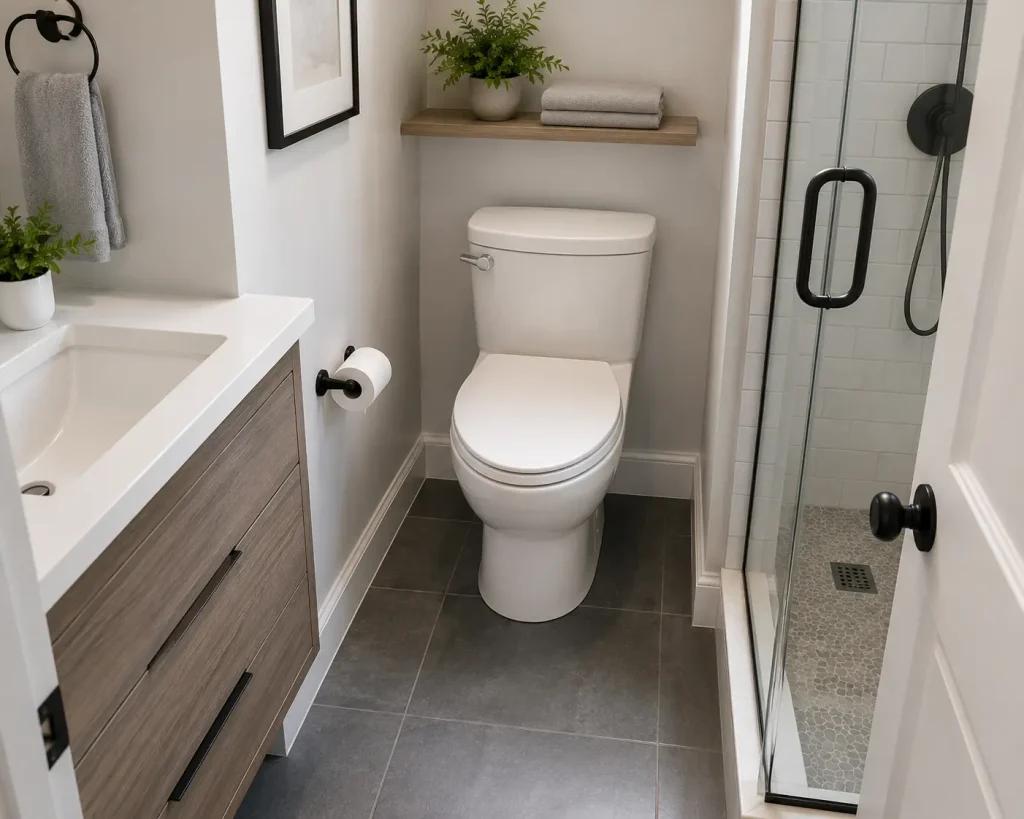
Round vs. Elongated Toilet for a Small Bathroom: Practical Comparison
| Consideration | Round | Elongated |
|---|---|---|
| Space efficiency | Excellent | Good |
| Small powder room | Excellent | Possible with careful measurements |
| Narrow bathroom | Usually better | Requires more planning |
| Adult comfort | Good | Usually better |
| Front clearance | Easier to achieve | More challenging |
| Style choices | Many | Many |
| Maintenance | Similar | Similar |
| Flushing performance | Depends on toilet design | Depends on toilet design |
| Price | Low to high | Low to high |
One important point: bowl shape does not determine flushing performance. A well-designed round toilet can flush better than a poorly designed elongated toilet. Compare the complete toilet model, including its flushing system, trapway design, water consumption, and manufacturer specifications.
Does a Round Toilet Flush Better Than an Elongated Toilet?
No. Bowl shape alone doesn’t tell you how well a toilet will flush.
Modern toilets use different flushing technologies, including gravity-fed, pressure-assisted, siphonic, and washdown systems. The flushing performance depends on the toilet’s engineering rather than simply whether the bowl is round or elongated.
If flushing performance is your main concern, compare the actual toilet specifications and independent performance testing rather than assuming one bowl shape is stronger.
This distinction is important because I’ve seen homeowners choose a round toilet expecting better flushing simply because it looked more compact. The bowl shape wasn’t the reason for the flushing performance.
Does a Round Toilet Cost Less Than an Elongated Toilet?
Not necessarily.
Round toilets are often available in inexpensive models, but both round and elongated toilets exist at entry-level, mid-range, and premium price points.
Installation labor is also generally not determined by bowl shape alone. If the replacement uses the existing rough-in and requires no plumbing relocation, the installation may be relatively straightforward regardless of whether the bowl is round or elongated.
The bigger cost issue in a small bathroom is often choosing a toilet that doesn’t fit the existing layout. Moving a toilet drain or water supply because the selected model doesn’t work with the room can be dramatically more expensive than the difference between two toilet models.
Real-World Scenarios: Which Toilet Should You Choose?
Scenario 1: You have a very narrow half bath
Choose round.
If the toilet faces a wall-mounted or shallow vanity and every inch matters, the shorter projection of a round-front toilet can make the room significantly easier to use.
Scenario 2: Your bathroom is small but reasonably wide
Measure before deciding.
If an elongated model still provides adequate front and side clearance, there is no reason to reject it simply because the room is small.
Scenario 3: The bathroom is mainly used by adults
Consider elongated if space permits.
If comfort is a priority and the room can accommodate the additional projection, an elongated bowl may be worth the trade-off.
Scenario 4: The bathroom door nearly hits the toilet
Choose the most compact compatible model.
Here, toilet projection becomes especially important. A round toilet may solve the problem, but a compact elongated model can also work if its dimensions fit the available space.
Scenario 5: You’re replacing an existing toilet without remodeling
Measure the existing toilet first.
Record the distance from the finished wall to the front of the existing toilet, the rough-in dimension, and the available side clearance. Then compare those measurements with the manufacturer’s specification sheet.
What About a Compact Elongated Toilet?
This is an option many homeowners overlook.
A compact elongated toilet uses an elongated bowl shape while reducing the overall projection compared with some standard elongated models.
For someone who wants the seating characteristics of an elongated bowl but has limited space, this can be an excellent compromise.
However, don’t assume the phrase “compact elongated” means a specific universal dimension. Manufacturers use different designs, so compare the actual product dimensions.
In a small bathroom, I would rather see a homeowner compare three or four actual measurements than choose a toilet based solely on the label “round” or “elongated.”
How to Measure Before Buying a Toilet for a Small Bathroom
Before ordering the toilet, measure the bathroom carefully.
- Measure from the finished wall to the front of the existing toilet.
- Measure the available space in front of the toilet.
- Measure from the toilet centerline to nearby walls or fixtures.
- Check the rough-in dimension.
- Measure the door swing.
- Check the vanity or cabinet depth.
- Compare the manufacturer’s full toilet dimensions.
Don’t forget that the toilet seat and lid can extend slightly beyond the bowl depending on the model.
And if the bathroom is extremely tight, make a simple cardboard template using the manufacturer’s published dimensions. Put it on the floor where the toilet will sit and open the door. This is a surprisingly useful way to see whether the room will feel comfortable before you buy the fixture.
Common Questions About Round and Elongated Toilets
Is a round toilet better for a very small bathroom?
Usually, yes. A round-front toilet generally has a shorter front-to-back projection, making it easier to preserve usable floor space in a compact bathroom. Always compare actual model dimensions because designs vary.
Is an elongated toilet too big for a small bathroom?
Not necessarily. A compact elongated toilet can work well in a small bathroom if the room provides sufficient front and side clearance. The actual dimensions matter more than the bowl label.
Which is more comfortable, round or elongated?
Many adults prefer elongated toilets because the longer bowl provides more seating surface. However, comfort is personal, and a round toilet can be perfectly comfortable while providing better space efficiency.
Does a round toilet use less water?
Not inherently. Water consumption is determined primarily by the toilet’s flushing design and rated gallons per flush, not whether the bowl is round or elongated.
Can I replace an elongated toilet with a round toilet?
Often, but you must check the rough-in, mounting position, supply connection, and available clearance. The replacement toilet also needs to fit the existing drain configuration and bathroom layout.
Conclusion: Round or Elongated for a Small Bathroom?
If your bathroom is genuinely tight, I would normally start with a round-front toilet. Its shorter projection can preserve valuable floor space and make a narrow bathroom easier to move around in.
But don’t dismiss an elongated toilet automatically. If your measurements show enough clearance, a compact elongated model can give you better seating comfort without making the bathroom feel cramped.
The best choice isn’t simply “round versus elongated.” It’s the toilet that fits your rough-in, front clearance, side clearance, door swing, vanity, and daily usage without sacrificing comfort.
For a very small powder room, prioritize compact dimensions. For a small but reasonably spacious family bathroom, prioritize the combination of comfort and fit. And if you’re somewhere in between, compare a compact elongated model with a round model before making the final decision.