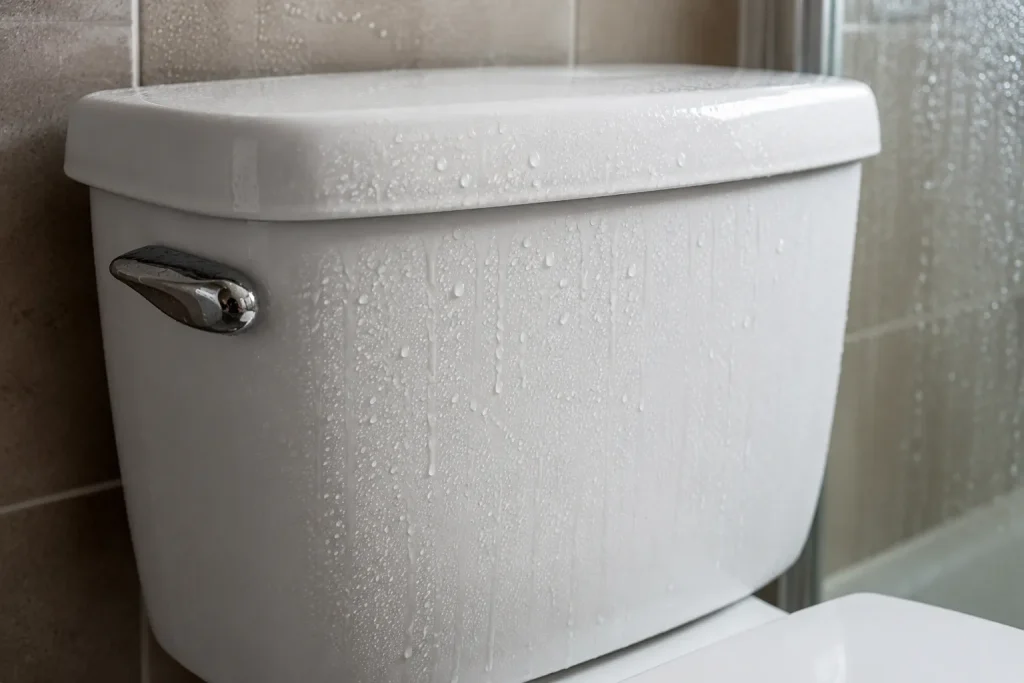
If you notice water droplets forming on the outside of your toilet tank during a hot summer day, your first thought may be that the tank is leaking. In many cases, however, the toilet is not leaking at all. It is condensation, commonly called a “sweating toilet tank.”
The basic cause is simple: warm, humid bathroom air comes into contact with a toilet tank that has been cooled by cold water from the supply line. When the tank surface falls below the air’s dew point, moisture in the air turns into liquid water on the porcelain.
This is especially common during hot, humid weather, after a hot shower, or in bathrooms with poor ventilation. A toilet that is constantly running can make the problem noticeably worse because fresh cold water keeps entering the tank.
Quick conclusion: In most cases, a sweating toilet tank is a condensation problem rather than a plumbing leak. Start by confirming where the water is coming from, then reduce bathroom humidity, check whether the toilet is running, and consider tank insulation or an anti-sweat valve if the problem continues.
Why Does a Toilet Tank Sweat in Hot Weather?
The easiest way to understand the problem is to think about a cold glass of iced water on a summer afternoon. The glass does not produce water. Instead, moisture already present in the surrounding air condenses on its cold surface.
Your toilet tank can behave in exactly the same way.
After you flush, the tank refills with relatively cold water. In many homes, incoming water can be around 50–60°F, although the actual temperature depends on the local water supply, season, plumbing system, and location. When that cold water cools the porcelain tank, warm humid air surrounding the tank can reach its dew point and form droplets on the outside surface.
Hot weather makes the situation worse because warm outdoor conditions often raise indoor humidity, particularly when a bathroom has poor ventilation or receives frequent hot showers.
What Actually Causes Toilet Tank Condensation?
There usually isn’t one single cause. Instead, several conditions work together.
- High bathroom humidity: Hot showers, baths, and humid summer air add moisture to the room.
- Cold incoming water: Fresh supply water cools the tank and its porcelain walls.
- Poor ventilation: Moist air stays trapped in the bathroom instead of being exhausted.
- Frequent flushing: Every flush introduces another batch of cold water into the tank.
- A running toilet: A worn flapper or fill-valve problem can continuously replace warmer tank water with cold supply water.
- Uninsulated tank walls: The cold water can more easily cool the exterior porcelain.
The combination of cold tank + warm air + high humidity is what creates the familiar sweating effect.
How Can You Tell Condensation From a Toilet Leak?
This is the first thing I would check before buying an insulation kit or calling a plumber.
Water around a toilet does not automatically mean the toilet tank is sweating. A leaking supply connection, tank bolt, fill valve connection, or another plumbing component can produce a similar puddle.
| What you notice | More likely cause | What to check |
|---|---|---|
| Small droplets cover the outside of the tank | Condensation | Check whether the tank surface becomes wet evenly |
| Water appears mainly after a hot shower | Condensation | Improve ventilation and observe the tank afterward |
| Water starts around the supply connection | Plumbing leak | Inspect the shutoff valve and connection |
| Water comes from one fitting or bolt | Possible leak | Inspect the fitting rather than treating the tank for condensation |
| Tank remains wet even when the bathroom is cool and dry | Possible leak | Dry everything and monitor where new water appears |
| Toilet runs or refills by itself | Toilet mechanism problem | Check the flapper and fill valve |
A simple observation can save you a lot of unnecessary work. Dry the outside of the tank and the floor completely. Then avoid flushing for roughly 10–15 minutes and watch where the moisture first appears. If droplets gradually form across the cold tank surface, condensation is a strong possibility. If water begins at a specific connection, investigate a leak instead.
Why Does My Toilet Sweat More After a Hot Shower?
This is one of the most common situations I see.
Imagine a bathroom at about 72°F. You take a long hot shower, and suddenly the room becomes warm and humid. The toilet tank, meanwhile, has just been filled with cold water.
That creates exactly the conditions condensation needs.
The bathroom air contains more moisture, while the porcelain remains relatively cold. Once the tank surface is below the air’s dew point, water vapor changes into liquid droplets on the outside of the tank.
This is why a toilet may look completely dry in the morning but have water running down its sides after the family takes several showers.
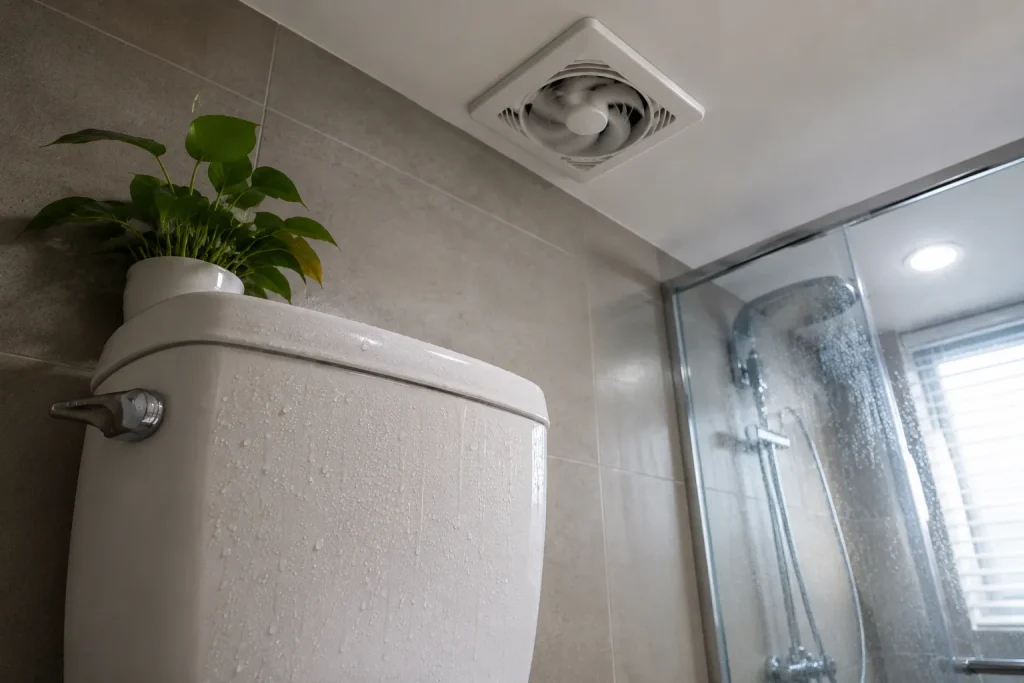
Practical tip: Run the bathroom exhaust fan during the shower and continue running it afterward so humid air has time to leave the room. Better ventilation is one of the simplest ways to reduce condensation.
Can a Running Toilet Make Tank Sweating Worse?
Yes. This is an easy detail to overlook.
A properly functioning toilet fills the tank and then stops. The water inside can gradually move closer to room temperature between flushes.
If the toilet has a worn flapper or a fill valve that does not shut off properly, fresh cold water may continuously enter the tank. That keeps the tank colder and makes condensation easier to form.
So if your toilet is both sweating and occasionally running, fix the running problem first.
There is little point in spending money on a condensation solution while the toilet is constantly introducing cold supply water into the tank. Plumbing professionals specifically recommend checking for a continuously running toilet before treating the condensation itself.
How to Stop Your Toilet Tank From Sweating
The right solution depends on how severe the condensation is and what is causing it.
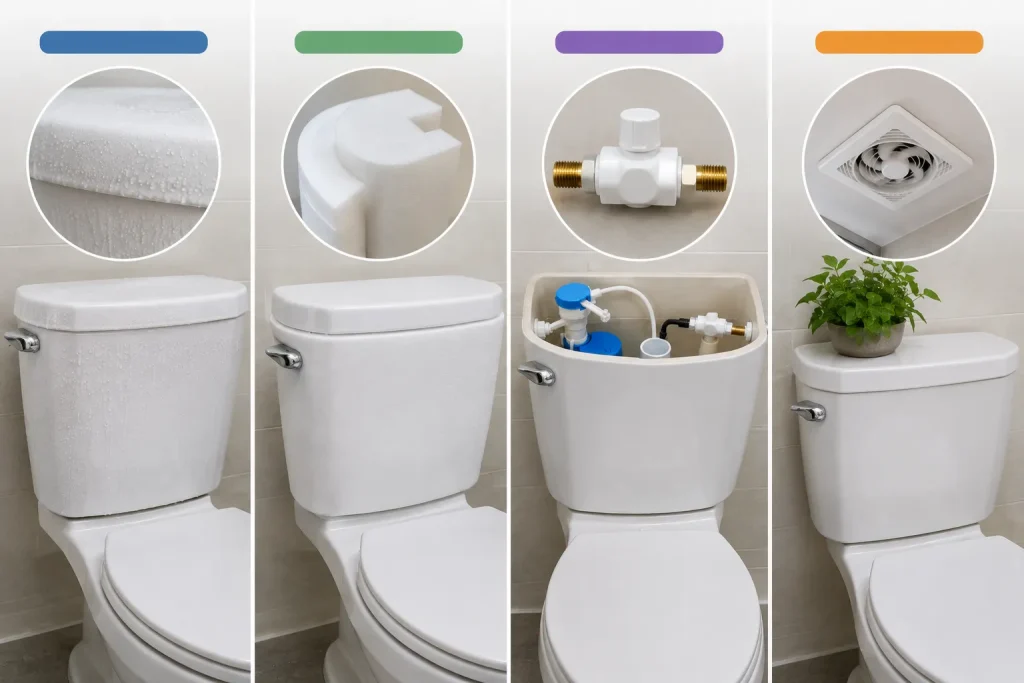
1. Improve Bathroom Ventilation
If condensation mainly appears after showers, start here.
- Run the exhaust fan while showering.
- Keep the fan running for a while after the shower.
- Open a bathroom window when practical.
- Allow humid air to escape rather than keeping the bathroom completely sealed.
This approach works by reducing the amount of moisture in the air rather than changing the toilet itself.
2. Reduce Bathroom Humidity
If your bathroom remains humid even when nobody is showering, the problem may be broader than ventilation.
Air conditioning naturally removes some moisture, while a properly sized dehumidifier can help in persistently humid rooms. This can be particularly useful in basements, small bathrooms, and homes where summer humidity remains high.
In practical terms, the dryer the bathroom air becomes, the harder it is for condensation to form on the cold tank surface.
3. Check for a Running Toilet
Listen for occasional hissing or water movement after the tank has supposedly finished filling.
If you hear the toilet periodically refilling without anyone flushing, inspect the flapper, fill valve, and water level. A malfunctioning component may be keeping the tank colder than necessary.
4. Install a Toilet Tank Insulation Liner
A tank liner creates a thermal barrier between the cold water and the porcelain wall.
In other words, instead of allowing the cold water to cool the outside surface as aggressively, the insulation helps keep the exterior surface closer to room temperature.
Tank insulation is particularly attractive when the bathroom humidity is reasonable but the incoming water is extremely cold.
However, installation quality matters. The tank should be clean and dry, the insulation should fit without interfering with the flush mechanism, and the liner should not obstruct moving components.
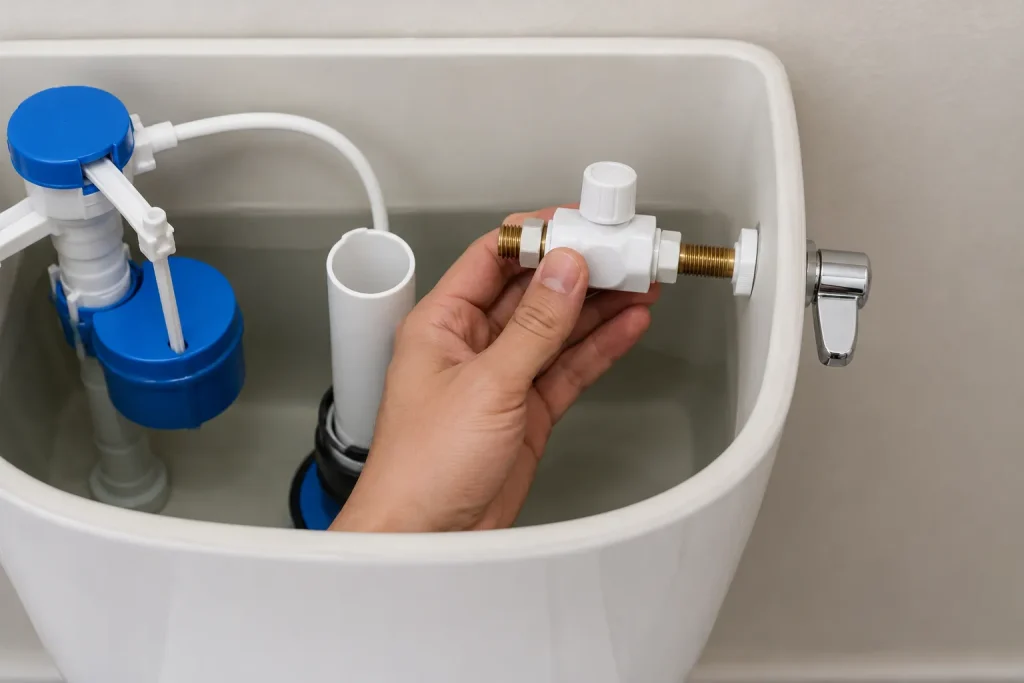
5. Consider an Anti-Sweat Valve
If condensation remains severe despite humidity control and insulation, an anti-sweat valve can be a more permanent approach.
This type of valve introduces a controlled amount of warmer water into the toilet’s cold-water supply, raising the temperature of the water entering the tank. The warmer tank surface is then less likely to fall below the dew point.
This solution involves modifying the water supply, so I would generally leave the installation to someone comfortable working with residential plumbing.
Adjustable models can also be useful because the amount of warming needed may change with the seasons.
Which Solution Is Best for Your Bathroom?
| Solution | Typical cost level | Installation | Maintenance | Main advantage | Limitation |
|---|---|---|---|---|---|
| Better ventilation | Low if fan already exists | Easy | Low | Reduces humidity | Less effective if the bathroom stays very humid |
| Dehumidifier | Low to moderate | Easy | Moderate | Controls room humidity | Uses electricity and requires maintenance |
| Tank insulation | Low | DIY-friendly | Low | Directly reduces heat transfer | Fit and installation quality matter |
| Anti-sweat valve | Moderate | More involved | Low | Effective for persistent condensation | Requires plumbing work |
| Replace with an insulated tank toilet | Higher | Professional installation recommended | Normal toilet maintenance | Built-in condensation resistance | Unnecessary if the existing toilet works well |
My practical recommendation: Don’t replace a perfectly good toilet simply because the tank sweats. First determine whether humidity, poor ventilation, or a running toilet is responsible. If the toilet itself is otherwise in good condition, insulation or humidity control is usually a more sensible first step.
For a bathroom that experiences extreme humidity every summer, an anti-sweat valve may make more sense than repeatedly dealing with puddles.
Can Toilet Tank Sweating Damage Your Bathroom?
A few droplets are not an emergency, but persistent condensation should not simply be ignored.
Water can repeatedly run down the tank and collect around the toilet. Over time, that moisture can contribute to staining, mold or mildew, damaged flooring, and deterioration of materials beneath the finished floor. In bathrooms with wood-based subfloors, repeated moisture exposure deserves particular attention.
One real-world example illustrates why this matters: a homeowner featured by This Old House initially suspected a plumbing leak after noticing water damage below a bathroom. The eventual cause was condensation from a sweating toilet tank above.
So if you’re regularly finding a wet floor around the toilet during summer, don’t assume the water will simply evaporate without consequences.
Real-World Scenarios: What Should You Do?
Scenario 1: The tank only sweats after showers
Best first move: improve ventilation.
This pattern strongly suggests that humidity is the main trigger. Run the exhaust fan during and after showers and see whether the amount of condensation decreases.
Scenario 2: The tank sweats all day during humid summer weather
Best first move: reduce room humidity and consider tank insulation.
If the bathroom is consistently humid, ventilation alone may not be enough. A combination of humidity control and insulation is more practical.
Scenario 3: The toilet sweats and makes a hissing sound
Best first move: investigate the running toilet.
Continuous refilling keeps cold water entering the tank. Fixing that problem may substantially reduce the condensation.
Scenario 4: There is a puddle but the tank exterior is dry
Best first move: look for a plumbing leak.
If the porcelain is not covered in condensation, don’t automatically blame “sweating.” Check the supply connection, tank fittings, and the area around the toilet base.
Scenario 5: You are remodeling the bathroom anyway
Best first move: consider an insulated tank toilet.
If you are already replacing the toilet, an insulated tank can reduce the chance of condensation without requiring you to retrofit the existing tank later.
How Do I Know if My Bathroom Is Too Humid?
A small digital hygrometer can give you a much better answer than guessing.
Instead of simply saying “the bathroom feels humid,” measure the relative humidity at different times:
- Before a shower.
- Immediately after a shower.
- 15–30 minutes after the exhaust fan has been running.
- During the time when the toilet tank normally sweats.
If you repeatedly see high humidity and the tank becomes wet at the same time, you’ve found a strong connection between the room environment and the condensation problem.
Remember that condensation depends on both humidity and surface temperature. There is no single humidity percentage that guarantees a tank will or will not sweat in every bathroom because the incoming water temperature and tank surface temperature also matter.
Common Questions About Sweating Toilet Tanks
Why does my toilet tank sweat only in summer?
Summer usually brings warmer and more humid air, while the water entering your toilet can remain relatively cold. The larger difference between humid room air and the cold tank surface makes condensation much more likely.
Is a sweating toilet tank a sign of a leak?
Not necessarily. If droplets form across the outside of the tank, condensation is likely. If water originates from a specific fitting, valve, connection, or the toilet base, investigate a plumbing leak instead.
Will insulating my toilet tank stop sweating?
It can significantly reduce condensation by limiting how much the cold tank water cools the exterior porcelain. It works best when the main problem is a cold tank rather than extremely high bathroom humidity.
Can a running toilet cause the tank to sweat more?
Yes. A running toilet continuously introduces fresh cold water into the tank, keeping the tank colder and increasing the potential for condensation. Fix the running problem before spending money on other condensation treatments.
Should I replace my toilet because the tank is sweating?
Usually not. If the toilet flushes properly and has no significant plumbing problems, start with ventilation, humidity control, checking for a running toilet, or tank insulation. Replacement makes more sense when you’re already planning a bathroom renovation or the existing toilet has other reasons to be replaced.
Conclusion: Don’t Mistake a Sweating Toilet Tank for a Leak
A toilet tank that “sweats” during hot weather is usually responding to the conditions around it. Cold water cools the tank, warm humid air reaches the dew point, and water droplets form on the porcelain.
The smartest approach is to diagnose the cause before replacing anything.
First, confirm whether the water is condensation or an actual leak. Then check for a running toilet, improve bathroom ventilation, reduce excessive humidity, and consider tank insulation if the problem persists. For severe or recurring condensation, an anti-sweat valve can provide a more permanent solution.
If your bathroom floor is repeatedly getting wet, don’t treat the puddle as harmless. A small amount of condensation repeated every day throughout a humid summer can eventually become a much more expensive moisture problem.