
A toilet seat that slides from side to side every time you sit down can make an otherwise solid toilet feel cheap, unstable, and frustrating to use. The good news is that a moving toilet seat is usually a simple maintenance issue rather than a sign that the entire toilet needs to be replaced.
In most cases, the problem comes down to loose mounting hardware, poor alignment, worn rubber washers or bushings, excessive movement around the mounting holes, or a hinge that has started to wear out.
The important part is figuring out what is actually moving before you start tightening anything. I have seen homeowners keep cranking down on the mounting bolts when the real problem was a worn hinge or a seat that was never centered correctly in the first place.
This guide walks through how to stop a toilet seat from moving or sliding, how to tell which repair makes sense, and when replacing the hardware or the entire seat is the better option.
Quick Answer
To stop a toilet seat from moving, first center the seat on the bowl and inspect the two rear mounting points. Clean the mounting area, then tighten both sides gradually and evenly.
If the seat still shifts after the bolts are secure, check the rubber washers, mounting bushings, hinge bases, and the amount of clearance around the toilet’s mounting holes. Replacing worn hardware or adding a compatible toilet-seat tightening kit can often eliminate the movement.
If the hinge is cracked, the seat is warped, or the hardware can no longer hold the seat securely, replacing the seat is usually more reliable than repeatedly tightening it.
Typical DIY time: 10 to 20 minutes for a basic loose-seat problem.
Typical DIY parts cost: About $5 to $25 for common washers, nuts, bolts, bushings, or a toilet-seat tightening kit. A complete replacement seat can cost considerably more depending on the material, hinge system, and features.
Why Does a Toilet Seat Move or Slide?
Not every unstable toilet seat has the same cause. The easiest way to diagnose the problem is to pay attention to exactly where the movement happens.
- The entire seat moves from side to side: The mounting hardware may be loose or the fixing points may have too much clearance.
- The seat stays centered but slides sideways when you sit down: The seat may not have enough grip at the mounting points, or the rubber components may be worn.
- The seat moves at the hinge: The hinge or hinge bushings may be worn or damaged.
- The seat keeps drifting out of alignment: The mounting hardware may not be holding its position properly.
- The whole toilet moves: This is a different problem. The toilet itself may have a floor-mounting or flooring issue.
That distinction matters because tightening a mounting bolt will not repair a cracked hinge, and a new washer will not fix a toilet that is actually rocking on the floor.
How to Stop a Toilet Seat From Moving or Sliding
1. Check the Seat Before Touching the Hardware
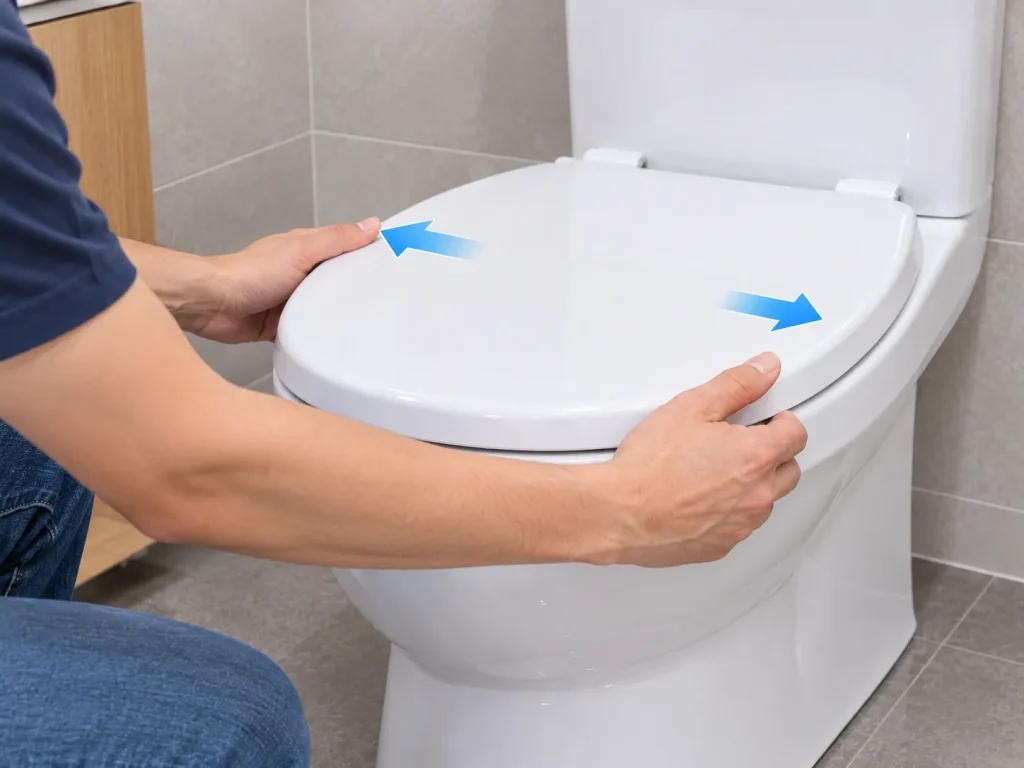
Close the toilet seat and gently push it from left to right. You are looking for where the movement originates.
Watch the two hinge areas at the rear. If both hinge bases move along with the seat, the mounting hardware is likely the problem. If the mounting bases stay relatively still while the seat itself moves, the hinge assembly may be worn.
Also place one hand on the bowl while you gently move the seat. If the porcelain bowl itself shifts, stop and investigate the toilet installation rather than trying to fix the seat with more pressure.
2. Open the Hinge Covers
Many toilet seats hide their mounting screws beneath plastic or metal-look hinge covers. Some use conventional screws and nuts, while others use quick-release or top-mount hardware.
Open the covers carefully and identify the fixing system before removing anything.
Do not force a hinge cover simply because it looks like it should pry open. Some designs use release tabs, buttons, or removable caps that can easily break if they are twisted with a screwdriver.
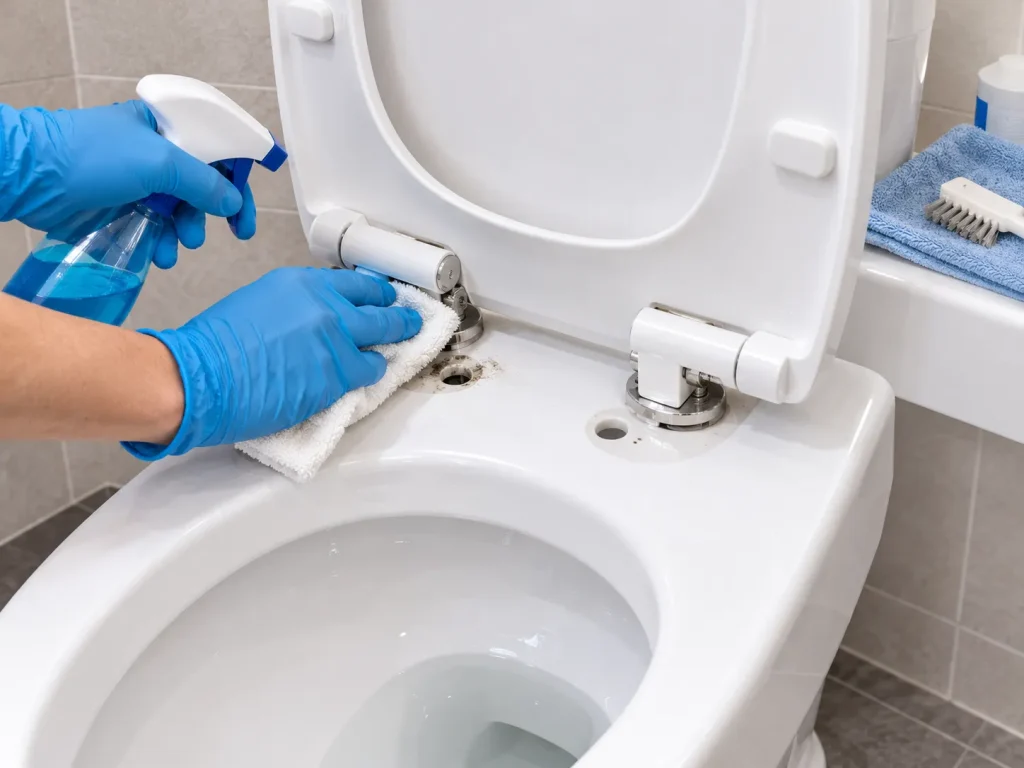
3. Clean the Mounting Area
Over time, cleaning products, dust, mineral residue, and bathroom grime can collect beneath the hinge bases and around the mounting hardware.
This matters because a mounting surface that should stay firmly positioned can become slippery or uneven when residue builds up underneath it.
If the seat can be removed easily, take it off and clean the porcelain around the mounting holes. Dry the area completely before reinstalling the seat.
For the seat itself, use a cleaner recommended by the manufacturer. Avoid abrasive pads and harsh chemicals that may damage plastic, painted hardware, or soft-close components.
4. Recenter the Toilet Seat
This is one of the most important steps and one of the easiest to skip.
Loosen the mounting hardware just enough to allow the seat to move. Then position the seat so the left and right sides sit evenly on the toilet bowl.
Look at the front edge as well. A seat can be centered at the hinges but still look slightly crooked at the front.
Once the seat is properly aligned, keep downward pressure on the hinge areas while tightening the hardware gradually.
Do not tighten one side completely while the other side remains loose. That can pull the seat out of alignment and create additional movement.
5. Tighten Both Mounting Points Gradually
Tighten the left and right sides in small steps rather than trying to finish one side in a single pass.
For a conventional bottom-mount system, the screw is usually tightened from the top while a nut or wing nut is held underneath the bowl. Some seats use top-mount expansion hardware that grips inside the toilet’s mounting hole.
The exact installation method depends on the seat and the hardware supplied with it.
Do not overtighten. The goal is to remove unwanted movement, not to apply as much force as possible. Excessive tightening can damage plastic components and place unnecessary stress on the toilet mounting area.
6. Test the Seat Before Finishing the Installation
Once the hardware is snug, gently move the seat from side to side again.
Open and close the seat several times. Check that it remains centered and that the hinges move smoothly.
If the seat now feels solid with normal hand pressure, the repair is probably complete.
If you still feel several millimeters of lateral movement, do not immediately tighten the bolts harder. That is the point where you should investigate the mounting hardware itself.
What If the Toilet Seat Is Tight but Still Slides?
This is one of the most common situations homeowners run into.
A mounting bolt can be tight while the seat still moves because the bolt is not the only component controlling lateral movement. The rubber washer, bushing, hinge base, mounting hole, and seat design all influence how stable the assembly feels.
| Possible Cause | What You May Notice | Recommended Fix |
|---|---|---|
| Loose mounting bolts | The entire seat moves at the rear | Center the seat and tighten both sides evenly |
| Worn rubber washer or bushing | Bolts feel tight but the seat still shifts | Replace the compatible rubber components |
| Excessive mounting-hole clearance | The hardware has room to move sideways | Use compatible bushings or a toilet-seat tightening kit |
| Worn hinge | The seat moves independently from the mounting base | Replace the hinge or the complete seat |
| Dirty mounting surface | The seat gradually moves out of alignment | Clean and dry the mounting area before reinstalling |
| Damaged seat | The seat flexes, twists, or does not sit flat | Replace the toilet seat |
| Moving toilet bowl | The entire toilet rocks on the floor | Inspect the toilet’s floor mounting separately |
When Should You Use a Toilet Seat Tightening Kit?
A toilet-seat tightening kit makes sense when the seat itself is still in good condition but the original mounting hardware cannot keep it from shifting.
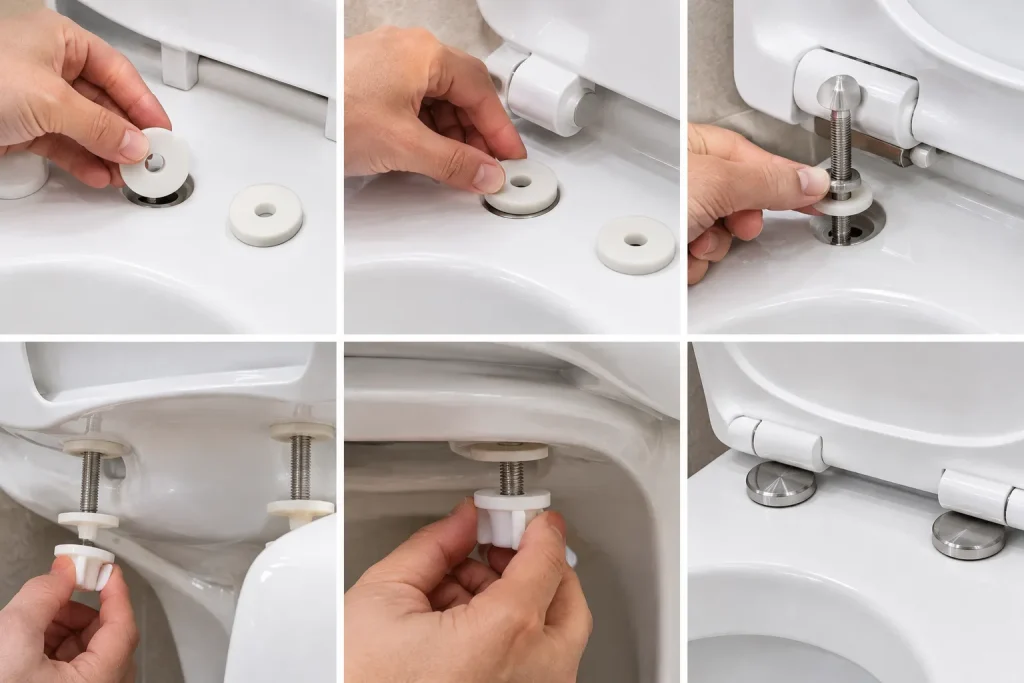
These kits commonly use replacement nuts, washers, rubber components, bushings, or other hardware designed to improve the fit between the toilet seat and the bowl.
They are particularly useful when:
- the bolts are already tight but the seat still moves;
- the original rubber components are worn or compressed;
- the mounting holes have noticeable clearance;
- the seat repeatedly becomes misaligned after normal use;
- you want to keep a relatively new toilet seat instead of replacing the whole thing.
Use hardware that matches the seat’s mounting system. Randomly adding thick rubber pieces underneath a hinge can create a new installation problem instead of solving the old one.
Can Rubber Washers Stop a Toilet Seat From Sliding?
In many situations, yes.
Rubber washers and bushings can increase friction and help stabilize the mounting assembly. They can be especially useful when the mounting hardware is secure but there is still a small amount of side-to-side play.
However, rubber components are not a cure for every problem.
If the hinge is cracked, the seat is warped, or the mounting hardware is stripped, a rubber washer will only mask the underlying problem temporarily.
Should You Add Silicone or Glue to a Moving Toilet Seat?
For a normally removable toilet seat, adhesive is usually not the first repair I would recommend.
Toilet seats are designed to be removed for cleaning, replacement, and maintenance. Gluing the seat to the bowl can make a future repair much more difficult and may trap moisture or cleaning residue around the mounting area.
It is better to correct the mechanical problem first: alignment, fasteners, washers, bushings, or the hinge.
How Tight Should a Toilet Seat Be?
A properly installed toilet seat should feel secure during normal use, but it should not require extreme force to keep it in place.
The practical test is simple: after tightening, use your hand to apply moderate sideways pressure to the seat. It should not shift significantly, while the hinge should still operate normally.
Do not use your full body weight as a test and do not stand on the toilet seat.
A common DIY mistake is assuming that more torque always means more stability. Once the mounting assembly is properly secured, additional force can create more risk without improving the fit.
Toilet Seat Repair Options Compared
| Repair Method | Typical DIY Cost | Installation | Maintenance | Advantages | Disadvantages |
|---|---|---|---|---|---|
| Tighten existing hardware | $0 | Easy | Low | Fast and free | May only provide a temporary fix |
| Replace washers or bushings | $5–$15 | Easy | Low | Good for reducing lateral movement | Parts must fit the mounting system |
| Replace mounting hardware | $5–$25 | Easy to moderate | Low | Useful when original hardware is worn | Incorrect hardware can cause fit problems |
| Replace the toilet seat | Varies by seat | Easy to moderate | Low | Best for cracked or worn seats and hinges | Higher upfront cost |
| Professional service | Varies by location | Professional | Depends on repair | Useful for installation-related problems | Usually unnecessary for a simple loose seat |
Real-World Situations: Which Fix Makes Sense?
If the Seat Only Moves a Little
Start with alignment and tightening. A small amount of movement is often caused by the seat being slightly off-center or the mounting hardware not being fully seated.
This is the quickest repair and costs nothing when the existing hardware is still in good condition.
If the Seat Slides Every Time You Sit Down
Do not assume the bolts simply need more force.
Check whether the hinge bases are moving on the porcelain. If the fasteners are already tight, inspect the rubber washers, bushings, and mounting-hole clearance.
This is a situation where a compatible tightening kit can make more sense than repeatedly tightening the same bolts.
If You Have a Soft-Close Toilet Seat
Soft-close seats deserve a little extra care because the hinge assembly often contains more components than a basic toilet seat.
If the mounting base is stable but the seat itself has developed movement near the hinge, inspect the hinge mechanism rather than forcing the seat into position.
If the hinge is damaged, replacing the seat or the manufacturer’s specified hinge assembly is usually more dependable than improvising a repair.
If the Seat Keeps Coming Loose Every Few Weeks
A seat that needs tightening again and again is telling you something.
Inspect the threads on the fasteners, the condition of the rubber components, the mounting holes, the hinge bases, and the underside of the mounting hardware.
Repeated loosening often means the hardware is moving under normal use instead of simply being under-tightened.
If Children or Older Adults Regularly Use the Toilet
Seat stability becomes more important when users are likely to shift their weight while sitting down, standing up, or transferring to and from the toilet.
In these situations, I would prioritize a properly fitted seat with a dependable mounting system over simply choosing the cheapest replacement.
The goal is not just to eliminate an annoying wobble. It is to make the fixture feel predictable during normal use.
If the Entire Toilet Rocks
This is a completely different problem.
Hold the bowl steady and check whether the porcelain itself moves when pressure is applied. If the whole toilet rocks, tightening the seat will not solve it.
The issue may involve the toilet’s floor mounting, flange, flooring, or installation condition. Deal with that problem separately before assuming the toilet seat is defective.
How to Prevent a Toilet Seat From Becoming Loose Again
Once you have fixed the seat, prevention is mostly about avoiding unnecessary stress on the mounting hardware.
- Keep the hinge and mounting area clean.
- Do not stand or kneel on the toilet seat.
- Avoid repeatedly pushing the seat sideways.
- Check the mounting hardware after installation and again after a period of normal use.
- Replace damaged washers, bushings, nuts, or bolts instead of endlessly retightening them.
- Follow the seat manufacturer’s cleaning and maintenance instructions.
A simple inspection every few months is usually enough for a normal household toilet. High-use bathrooms may benefit from checking the seat more frequently.
Common Mistakes to Avoid
- Do not overtighten the bolts. More force does not automatically create a better fit.
- Do not ignore the hinge. A damaged hinge cannot be repaired by tightening the mounting screw.
- Do not glue down a removable seat as the first solution. Mechanical problems should normally be corrected mechanically.
- Do not use incompatible washers. Incorrect thickness or size can interfere with the mounting system.
- Do not confuse a moving seat with a moving toilet. They require different repairs.
Frequently Asked Questions
Why does my toilet seat keep sliding from side to side?
The most common causes are loose mounting hardware, worn rubber washers or bushings, excessive clearance around the mounting holes, or a worn hinge. If the bolts are already tight, investigate the other components instead of simply tightening them harder.
How can I stop my toilet seat from moving without replacing it?
Center the seat, clean the mounting area, and tighten both mounting points evenly. If movement remains, compatible replacement washers, bushings, or a toilet-seat tightening kit may stabilize the existing seat.
Can I use rubber washers to keep a toilet seat from sliding?
Yes. Compatible rubber washers or bushings can improve friction and reduce side-to-side movement. They work best when the seat and hinge are otherwise in good condition.
Why does my toilet seat become loose again after I tighten it?
Recurring loosening can indicate worn fasteners, compressed rubber components, excessive clearance around the mounting holes, a contaminated mounting surface, or a damaged hinge. The recurring movement is usually a symptom of an underlying hardware problem.
When should I replace my toilet seat instead of repairing it?
Replacement makes more sense when the seat is cracked, warped, structurally damaged, or equipped with a hinge that can no longer stay secure. A relatively inexpensive seat may also be worth replacing when compatible replacement hardware is difficult to find.
Conclusion
A toilet seat that moves or slides is usually fixable without replacing the entire toilet. Start with the basics: find out where the movement is coming from, clean the mounting area, center the seat, and tighten both sides gradually.
If the seat remains loose after the bolts are secure, look at the washers, bushings, mounting holes, and hinge instead of applying more force. Those components often explain why a supposedly tight toilet seat still shifts under normal use.
For a healthy seat with good hinges, a small amount of replacement hardware can often restore a solid fit for very little money. When the seat or hinge is cracked or badly worn, however, replacement is usually the more dependable long-term solution.
The best repair is not the tightest repair. It is the repair that keeps the seat securely aligned without stressing the mounting hardware or the toilet.
For related toilet plumbing problems, Toilet Repair guides can help you troubleshoot leaks, running toilets, weak flushing, clogs, and other common toilet problems.