
Seeing a crack in a brand-new shower floor is frustrating. You have just finished a bathroom remodel, everything looks clean and new, and then a few weeks or months later you notice a thin line running through the tile or grout.
The first question most homeowners ask is, “Was the tile defective?” Sometimes it is. But in many cases, the crack is telling you something about what is happening underneath the finished surface.
A shower floor can crack because of movement in the subfloor, an improperly installed shower pan, inadequate mortar coverage, movement around the drain, incorrect grout installation, structural deflection, or a waterproofing assembly that was not designed or installed correctly.
The important point is that the visible crack is not always the actual problem. Repairing the crack without identifying what caused it can result in the same failure happening again.
Quick Answer: Why Does a Shower Floor Crack After Remodeling?
The most common reason a remodeled shower floor cracks is movement within the floor assembly. Tile and grout are relatively rigid, while a wood-framed bathroom floor, mortar bed, substrate, or improperly supported shower base can move slightly under load.
Other common causes include:
- Movement or deflection in the wood subfloor
- Improperly installed shower pan
- Insufficient mortar coverage beneath tile
- Tile installed over an unsuitable substrate
- Improperly cured mortar or grout
- Movement around the shower drain
- Missing or incorrectly installed movement joints
- Water damage beneath the shower assembly
- Cracked or poorly supported shower base
- Improper waterproofing or drainage
The location and appearance of the crack can provide useful clues about which problem you are dealing with.
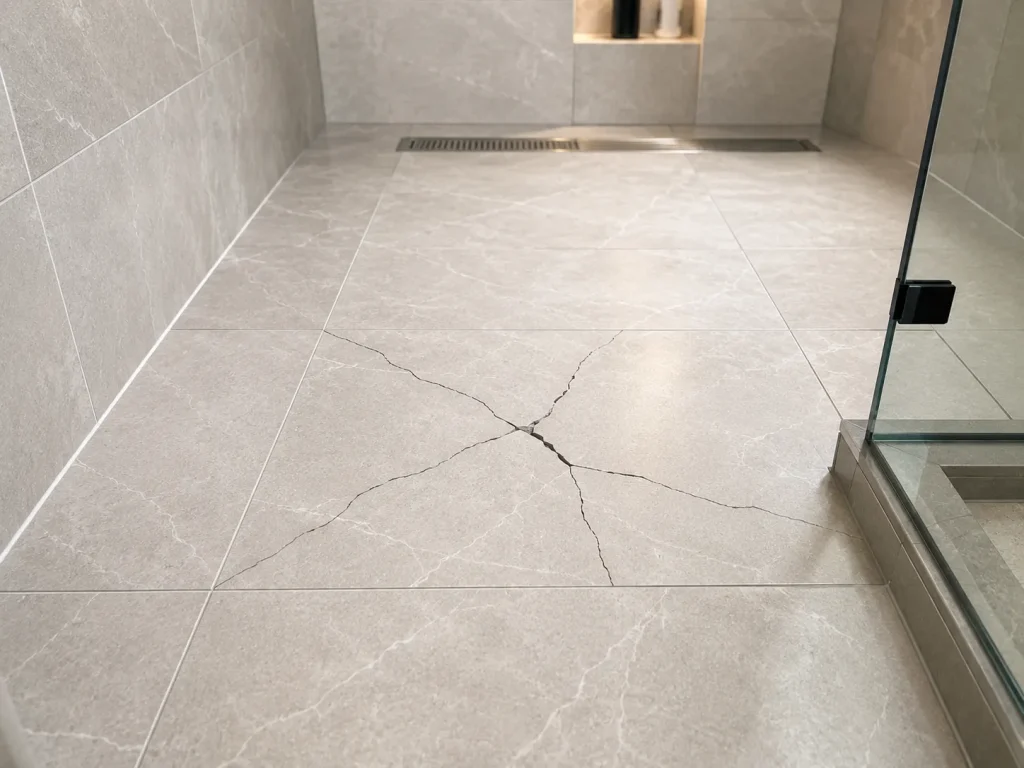
1. The Subfloor Is Moving Under the Shower
This is one of the first things I would investigate, especially in a wood-framed home.
A typical American bathroom may be built over wood joists with plywood or OSB subflooring. When people walk across the floor, the framing naturally experiences a small amount of movement.
That movement normally is not a problem. The problem occurs when the finished shower assembly is not adequately designed to accommodate it.
Tile and grout do not like repeated movement. If the substrate flexes underneath them, stress can concentrate along grout joints or through individual tiles.
Over time, that stress can produce:
- Hairline cracks in grout
- Cracked individual tiles
- Loose tiles
- Cracks running across several tiles
- Cracks around the shower drain
Real-world clue: if the crack becomes more noticeable when someone stands in the shower or if nearby tiles sound hollow or move slightly, I would investigate the substrate before simply replacing the cracked tile.
2. The Shower Pan Was Not Properly Supported
A prefabricated shower base needs continuous and appropriate support according to its manufacturer’s installation requirements.
If the base is not properly supported, it can flex when someone steps into the shower.
Imagine standing on a plastic tray that has support only around its edges. The center may move slightly every time you put your weight on it. That repeated movement can eventually cause cracking, noise, or separation in the finished assembly.
This is why the installation instructions for the specific shower base matter.
Do not assume that every shower pan should simply be placed on the subfloor and fastened to the wall.
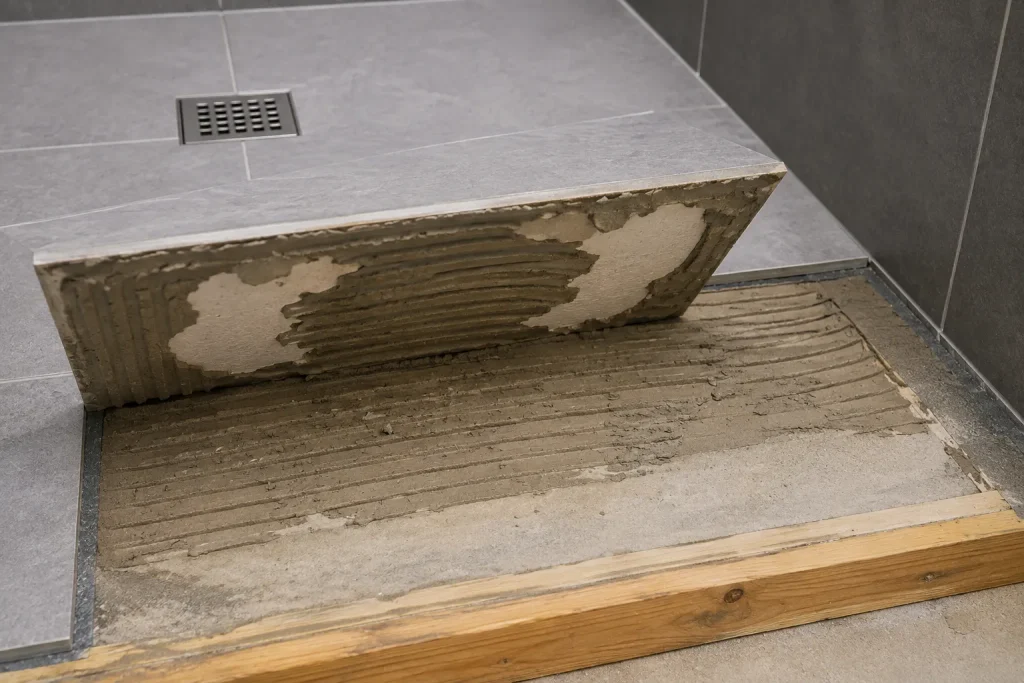
3. The Mortar Coverage Under the Tile Was Inadequate
Another common problem is insufficient mortar coverage beneath the shower floor tile.
Tile is not supposed to be supported only at a few isolated points.
When large voids exist beneath a floor tile, the tile can flex when somebody steps on it. A small amount of movement repeated hundreds or thousands of times can eventually cause cracking.
This becomes particularly important with larger-format tile.
Large tiles need appropriate mortar application and coverage. The installer also needs to account for the tile’s size, substrate, mortar type, and installation environment rather than using exactly the same technique used for a small wall tile.
4. The Tile Was Installed Over the Wrong Substrate
Tile should not be treated as a structural layer.
It needs an appropriate substrate underneath it.
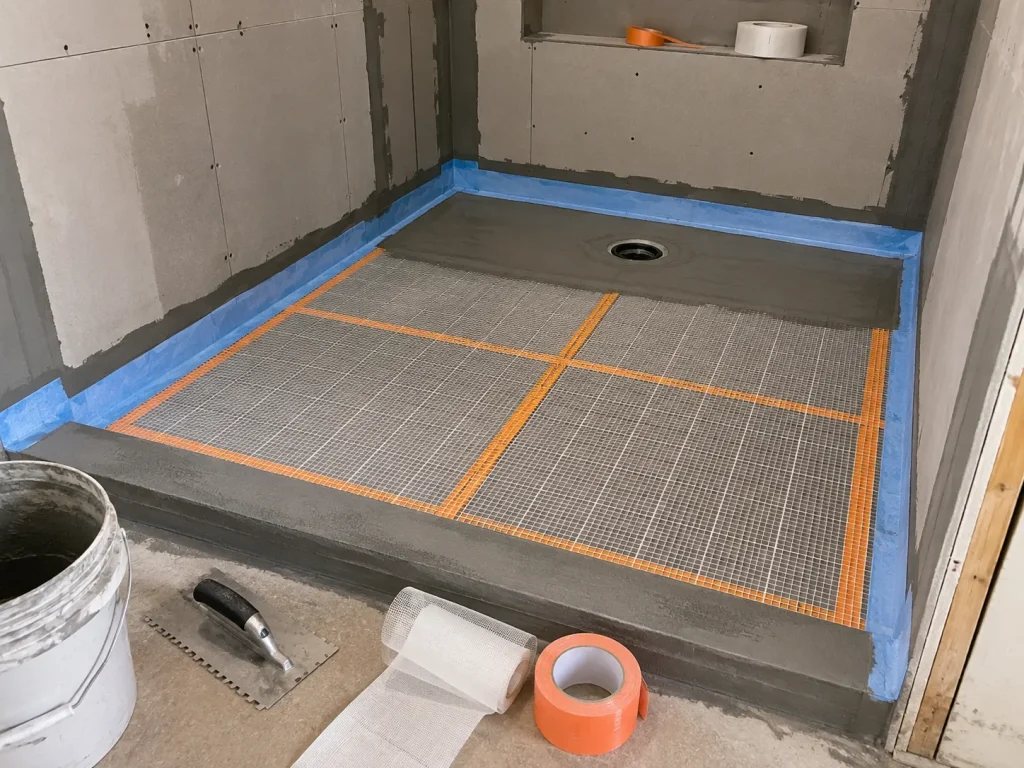
Depending on the shower design, the assembly may include a wood subfloor, mortar bed, cement backer board, foam shower base, waterproofing membrane, thin-set mortar, and tile.
Each layer has a specific purpose.
If an installer skips a required layer or substitutes an incompatible material, the finished tile surface may become vulnerable to movement and moisture.
This is particularly important when remodeling an older bathroom. The existing floor may look solid, but the original substrate may not have been designed for the new shower configuration.
5. The Shower Drain Is Moving
If the crack is concentrated around the drain, I would pay special attention to the drain assembly and surrounding substrate.
The drain is one of the most complicated areas of a shower floor because several components meet in a relatively small space:
- Shower floor
- Waterproofing layer
- Drain body
- Drain connection
- Tile
- Mortar or thin-set
If the drain moves independently from the surrounding floor, the rigid tile or grout around it can crack.
A small circular crack or separation around the drain does not automatically mean the waterproofing has failed, but it deserves investigation before the area is simply regrouted.
6. The Grout Cracked Because the Floor Assembly Moved
Sometimes homeowners see a crack and immediately blame the grout.
Grout can certainly fail because of poor mixing, incorrect installation, inadequate curing, or unsuitable conditions. But cracked grout can also be the visible result of movement underneath the floor.
This distinction matters.
If you remove the cracked grout and replace it without addressing movement in the floor assembly, the new grout may crack again.
| What You See | Possible Cause | What to Investigate |
|---|---|---|
| Single grout joint crack | Movement or grout installation issue | Substrate and adjacent tiles |
| Several cracks forming a line | Substrate movement or joint stress | Floor structure and tile layout |
| Tile itself is cracked | Movement, impact, void beneath tile | Tile support and substrate |
| Crack around drain | Drain movement or detailing issue | Drain assembly and waterproofing |
| Cracks plus loose tiles | Bonding or substrate problem | Tile removal and substrate inspection |
7. The Wood-Framed Floor Has Excessive Deflection
If your bathroom is located on a wood-framed floor, structural deflection deserves special attention.
Deflection is simply the amount a structural member or floor assembly bends under load.
You may not notice a problem when standing in the bathroom, but the floor can still move enough to stress a rigid tile installation.
This is one reason a shower remodel should not be approached as a purely cosmetic project.
If the original bathroom had vinyl flooring and you replace it with a heavy tile shower, the requirements of the finished assembly may be different.
My rule of thumb during a renovation: if the floor feels noticeably springy before the tile goes down, stop and investigate it. Waterproofing and tile cannot compensate for inadequate structural support.
8. The Waterproofing Assembly Was Installed Incorrectly
Waterproofing itself may not directly cause a tile crack, but a poorly designed or installed waterproofing assembly can contribute to long-term problems.
For example, water that gets trapped in an improperly constructed shower assembly can contribute to deterioration of surrounding materials.
In a wood-framed bathroom, prolonged moisture exposure is especially concerning because the structural components depend on remaining reasonably dry.
Look for combinations of symptoms rather than focusing only on the visible crack:
- Persistent dampness
- Musty odor
- Soft areas
- Loose tiles
- Discolored grout
- Water appearing outside the shower
- Ceiling staining below the bathroom
If cracking occurs together with these symptoms, I would investigate the waterproofing and drainage system rather than treating the crack as a cosmetic defect.
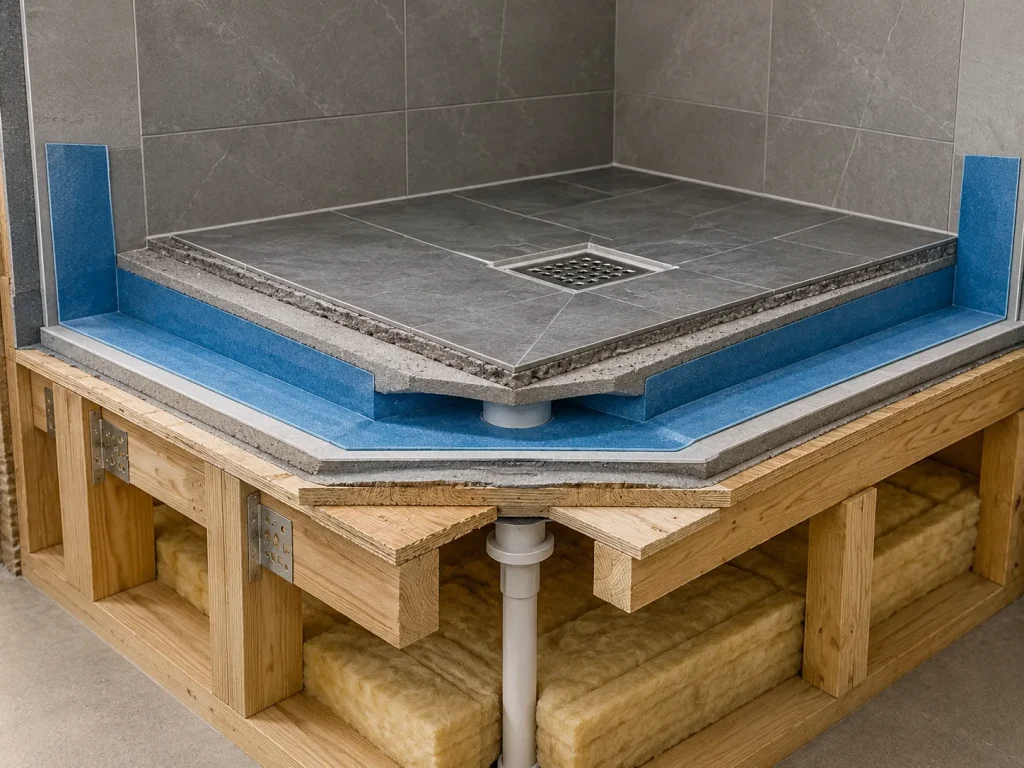
9. The Shower Floor Was Not Properly Sloped
A shower floor needs to direct water toward the drain.
If the slope is incorrect, water can remain in low areas instead of draining efficiently.
Pooled water does not automatically cause a tile to crack, but poor drainage can contribute to prolonged moisture exposure and may indicate problems with the underlying shower assembly.
For a traditional tiled shower, the finished surface and underlying drainage system need to work together.
A floor that looks nearly flat may feel acceptable when dry but reveal drainage problems once the shower is running.
10. The Mortar or Grout Was Not Given the Correct Conditions to Cure
Mortar and grout are not simply materials that “dry.” Their performance depends on proper mixing, application, temperature, moisture conditions, and curing according to the product requirements.
Using too much water during mixing can alter the material’s performance. Installing products outside their specified conditions can also create problems.
This is particularly relevant during fast bathroom remodels.
A homeowner may be told that the shower will be ready the next morning, but different products have different curing requirements.
Never assume that a universal 24-hour rule applies to every shower material.
Follow the manufacturer’s published requirements for the specific mortar, grout, membrane, sealant, and waterproofing system.
11. Large-Format Tile Can Make Installation Errors More Noticeable
Large-format tile is popular in modern bathrooms because it creates fewer grout lines and a clean appearance.
But larger tile also changes the installation requirements.
A small tile can sometimes accommodate minor variations in the substrate more easily. Large tile has a larger footprint and can bridge uneven areas, creating unsupported sections underneath.
On a shower floor, there is also the issue of slope.
A large-format tile may not be appropriate for every shower floor configuration because the surface needs to follow the required drainage slope. Smaller tiles can often conform to changes in plane more easily.
This is one reason you should choose the shower floor tile based on the shower design rather than selecting the largest tile simply because it looks modern.
Should You Repair or Replace the Cracked Shower Floor?
The correct repair depends on the severity and location of the crack.
| Condition | Possible Response | Priority |
|---|---|---|
| Small grout crack with no movement | Inspect and repair grout if substrate is sound | Low–Moderate |
| Single cracked tile | Replace tile after checking substrate | Moderate |
| Repeated cracking in same area | Investigate underlying movement | High |
| Loose or moving tiles | Inspect substrate and bonding | High |
| Cracking around drain | Inspect drain and waterproofing details | High |
| Cracks plus water damage | Investigate shower assembly | Very High |
The key rule is this: do not automatically regrout a shower floor that keeps cracking.
Repeated cracking is information. It suggests that something beneath the grout may still be moving or failing.
How I Would Diagnose a Cracked Shower Floor
If I were inspecting a recently remodeled shower, I would not start by grabbing a tube of grout.
I would work from the visible symptom toward the underlying assembly.
Step 1: Identify Exactly What Is Cracked
Is the crack in the tile, grout, shower base, or sealant?
These are different problems.
Step 2: Check Whether the Area Moves
Carefully observe whether the tile or shower base moves when normal weight is applied. Do not deliberately overload a damaged shower floor.
Step 3: Look for Water Symptoms
Check nearby walls, ceilings below the bathroom, baseboards, and adjacent flooring for signs of moisture.
Step 4: Inspect the Drain Area
Look for separation, cracking, movement, or unusual gaps around the drain.
Step 5: Check the Installation History
If possible, find out what waterproofing system, shower pan, backer board, mortar, and grout were used.
Step 6: Determine Whether the Problem Is Isolated
A single damaged tile is very different from a pattern of cracks across the entire shower floor.
If multiple areas are failing, assume there may be an underlying installation or substrate issue until proven otherwise.
Real-World Example: A New Shower That Cracks After Three Months
Consider a second-floor bathroom in a wood-framed house.
The homeowner has a new tiled shower installed. Everything looks perfect at first. About three months later, a crack appears across one grout joint near the center of the shower floor.
The homeowner removes the grout and fills the joint again.
Several weeks later, the crack returns.
At this point, I would stop treating the grout as the problem.
I would investigate whether the substrate is moving, whether there is adequate support beneath the shower floor, whether the shower pan or mortar bed was installed correctly, and whether the tile has adequate support underneath it.
If the crack is directly associated with movement or a structural issue, a cosmetic repair will only reset the clock.
This is the difference between repairing the symptom and repairing the cause.
How Much Does It Cost to Repair a Cracked Shower Floor?
The cost can range from a relatively small tile repair to a major shower reconstruction.
| Repair Situation | Relative Cost | Work Required |
|---|---|---|
| Minor grout repair | $ | Remove damaged grout and repair |
| Single tile replacement | $–$$ | Remove tile and install replacement |
| Several loose tiles | $$ | Inspect and repair substrate/bonding |
| Drain-area repair | $$–$$$ | Detailed inspection and localized reconstruction |
| Failed shower waterproofing | $$$ | Partial or complete shower reconstruction |
| Structural/subfloor repair | $$$ | Open floor and repair framing/subfloor |
Actual prices vary significantly by location, access, shower size, tile material, labor rates, and the extent of hidden damage.
The cheapest repair is not always the least expensive solution long term. If a shower has repeatedly cracked because of movement, replacing grout every few months can become more expensive than correcting the underlying problem once.
When Should You Stop Using the Shower?
A small isolated grout crack does not automatically mean the shower is unsafe to use.
However, I would take the situation more seriously if you notice:
- Water leaking outside the shower
- Water staining on the ceiling below
- Soft or spongy flooring
- A shower base that visibly moves
- Multiple cracked or loose tiles
- Persistent dampness
- Musty odors
- Rapidly recurring cracks
If water is reaching the wood structure or another concealed area, limiting use until the source is investigated can help prevent additional damage.
How to Prevent Shower Floor Cracks During a Remodel
- Inspect the framing and subfloor before installing the new shower.
- Repair damaged or weakened wood before covering it.
- Use a substrate appropriate for the intended tile assembly.
- Choose a complete compatible waterproofing system.
- Install the shower pan or mortar bed according to manufacturer requirements.
- Provide appropriate support beneath the shower floor.
- Use the correct mortar and application method for the tile.
- Follow manufacturer requirements for mortar and grout curing.
- Detail the drain connection correctly.
- Maintain the required shower floor slope.
- Do not ignore movement in the floor assembly.
- Protect waterproofing from damage during subsequent construction.
Frequently Asked Questions
Why did my new shower floor crack after only a few months?
A new shower floor can crack because of substrate movement, inadequate support, poor mortar coverage, drain movement, improper installation, or a problem with the shower pan or waterproofing assembly. A recurring crack should be investigated rather than repeatedly repaired cosmetically.
Can I simply replace the cracked shower tile?
You can replace an individual cracked tile when the surrounding assembly is sound, but first determine why it cracked. If the substrate moves or the tile lacks adequate support, the replacement tile may crack again.
Why does grout crack on a shower floor?
Cracked grout can result from movement, improper installation, incorrect mixing, inadequate curing, or unsuitable joints. If the same area repeatedly cracks, investigate movement beneath the grout instead of assuming the grout itself is the only problem.
Is a cracked shower floor a waterproofing problem?
Not necessarily. A cracked tile or grout joint does not automatically mean the waterproofing membrane has failed. However, cracking combined with leaks, dampness, loose tiles, or damage outside the shower deserves a more thorough inspection of the waterproofing and drainage assembly.
Can a wood subfloor cause shower tiles to crack?
Yes. Excessive movement or deflection in a wood-framed floor can place stress on a rigid tile assembly. The structural floor should be adequately supported before the shower waterproofing and tile system are installed.
Conclusion
A cracked shower floor after a bathroom remodel is frustrating, but the crack itself is often only the visible symptom.
The most important question is not simply “How do I fill this crack?” It is “Why did this part of the shower move or fail?”
Start by identifying whether the crack is in the tile, grout, shower base, or sealant. Then look at the substrate, shower pan, mortar coverage, drain, waterproofing, and structural support.
For a wood-framed bathroom, pay particular attention to floor movement and subfloor condition. For a tiled shower, the waterproofing system, shower floor support, drainage, and tile installation all need to work together.
A small isolated grout repair may be all that is needed in one bathroom. In another, recurring cracks may be an early warning sign of a much larger installation problem.
The best repair is the one that addresses the cause—not just the crack you can see.
If you are dealing with cracked shower floors, failed membranes, leaks, or other moisture-related bathroom problems, see the Bathroom Waterproofing category for practical waterproofing and repair guides.