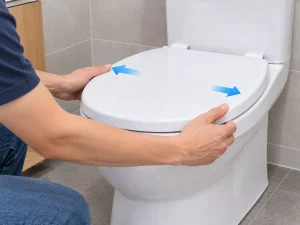
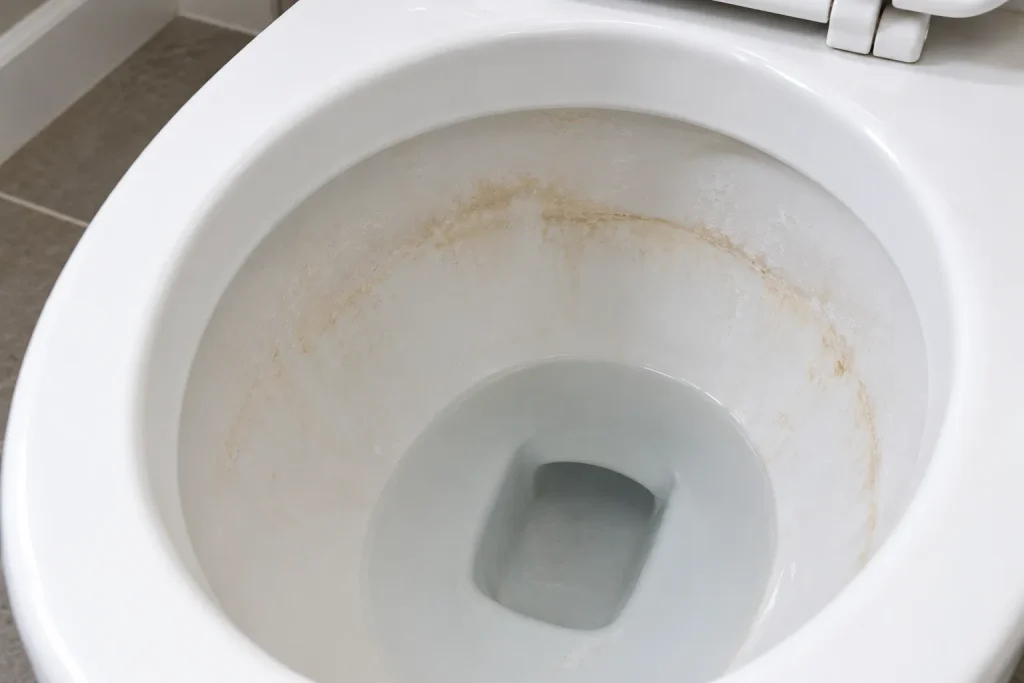
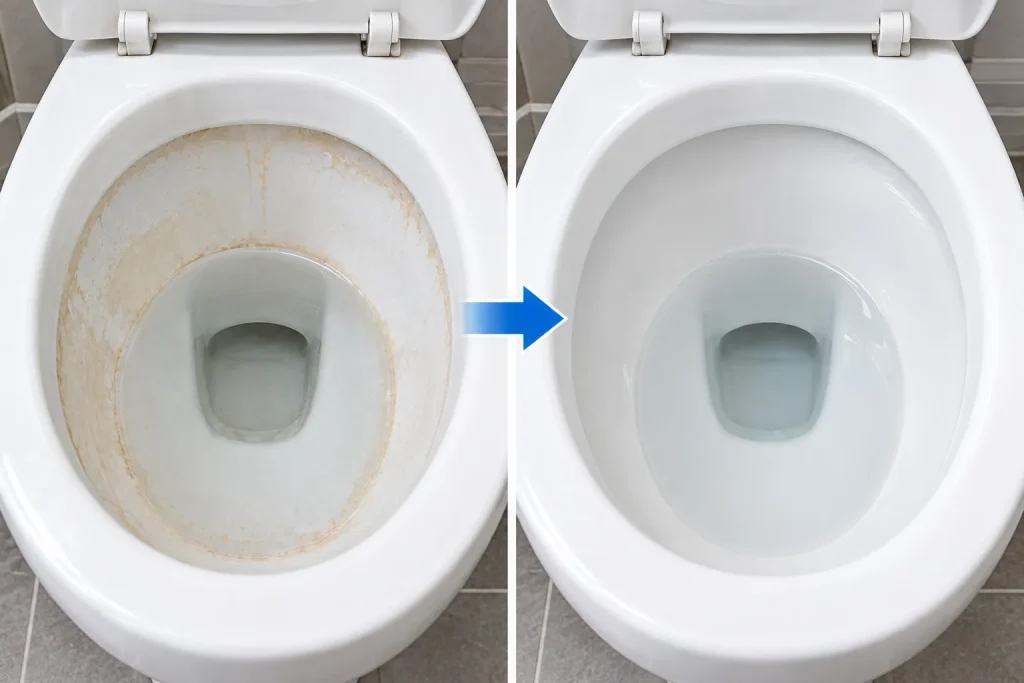
That hard white, gray, or brown crust around the inside of your toilet bowl is often more than ordinary dirt. In homes with hard water, calcium and other mineral deposits can gradually build up on the porcelain and become surprisingly difficult to scrub away.
The good news is that you usually do not need to replace the toilet just because you see mineral buildup. The right descaling product, enough contact time, and the right cleaning tool can make a major difference.
Quick Answer: What Removes Calcium Buildup From a Toilet?
A toilet-safe calcium, lime, and mineral deposit remover is one of the most direct options for stubborn buildup. For lighter deposits, some homeowners also use white vinegar, while severe deposits may require repeated descaling and careful mechanical cleaning.
The important part is choosing a product that is appropriate for your toilet surface and following its instructions. For example, CLR’s official toilet-cleaning method calls for removing most of the water from the bowl, applying the product, allowing it to work for a limited period, scrubbing, and then flushing thoroughly.
Why Does Calcium Buildup Form in a Toilet?
Calcium buildup is usually associated with hard water. As water repeatedly sits on or flows across the porcelain surface, dissolved minerals can remain behind after the water evaporates. Over time, those minerals form a hard, chalky or crusty deposit.
You may notice the buildup around the waterline, beneath the rim, or in areas where water frequently flows during flushing. Hard-water scale can also accumulate around toilet components and other plumbing fixtures.
What You Need to Remove Calcium Buildup
| Item | Purpose |
|---|---|
| Toilet-safe descaling cleaner | Break down calcium and mineral deposits |
| Rubber cleaning gloves | Protect your hands during cleaning |
| Toilet brush | Scrub loosened mineral deposits |
| Small detail brush | Reach narrow areas around the rim |
| Flashlight or small mirror | Inspect hidden buildup |
Step 1: Turn Off the Toilet’s Water Supply
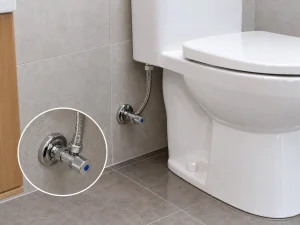
Before working on heavy buildup, turn the shutoff valve behind or beside the toilet clockwise to stop the incoming water.
This makes it easier to lower the water level in the bowl and prevents fresh water from immediately diluting the cleaner.
Step 2: Lower the Water Level
Flush the toilet and hold the handle down for a few seconds so as much water as possible leaves the bowl.
For a stubborn mineral ring, getting the affected area above the waterline can help the cleaner remain in contact with the deposit rather than becoming heavily diluted.
Step 3: Apply a Calcium or Limescale Remover
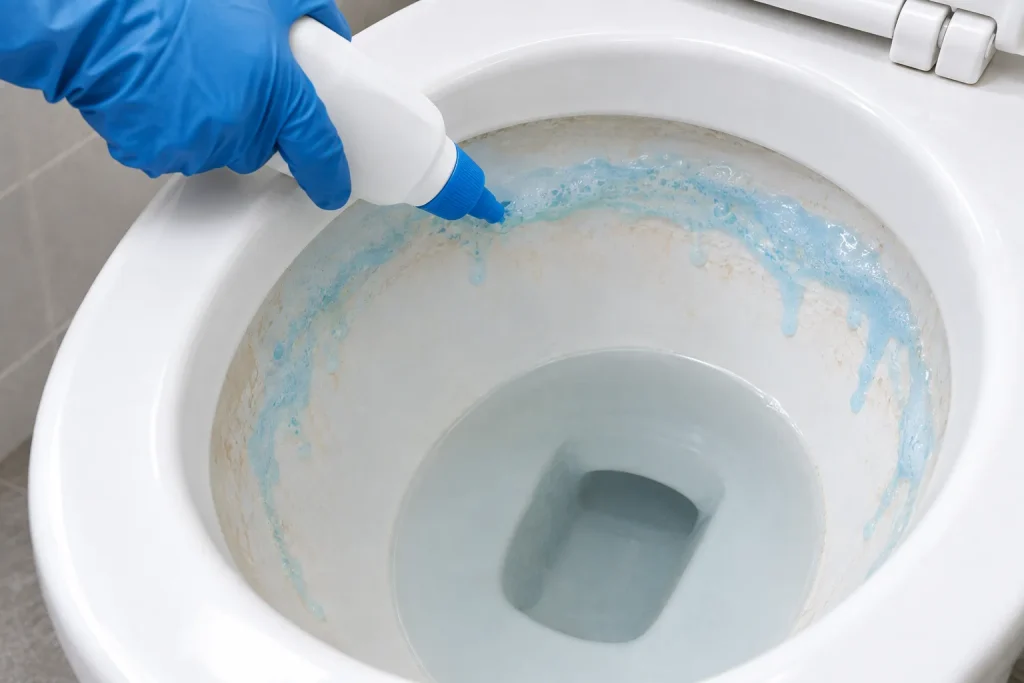
Use a product specifically labeled for toilet-bowl or porcelain-safe mineral deposit removal. Apply it directly to the affected areas rather than spreading it over the entire bathroom.
Always read the product label before use. Different descaling products have different contact times, dilution requirements, and surface restrictions.
For example, CLR’s published instructions for toilet hard-water stains specify applying the product after draining the bowl, waiting two minutes, scrubbing, and then flushing thoroughly.
Step 4: Scrub the Softened Buildup
After the cleaner has had the recommended amount of time to work, scrub the affected surface with a toilet brush or another tool approved for the toilet’s finish.
Work in small sections instead of trying to remove a thick layer all at once. Heavy scale may require more than one cleaning cycle.
For a pumice stone, be especially careful. Some maintenance sources recommend a wet pumice stone for stubborn mineral deposits on porcelain, while other plumbing guidance advises against abrasive tools because incorrect use can damage the finish. The safest approach is to follow the toilet manufacturer’s surface-care instructions rather than assuming every porcelain toilet can be treated the same way.
Step 5: Rinse and Flush Thoroughly
Once the deposit has been loosened, turn the water supply back on and flush the toilet several times as needed to rinse away the remaining cleaner and mineral residue.
Do not leave a strong descaling product sitting on the toilet longer than the manufacturer recommends.
What About White Vinegar?
White vinegar can help with lighter mineral deposits because its acidity can react with calcium-based scale. It is generally more useful when the buildup is relatively thin and the solution can remain in contact with the affected surface long enough to work.
For heavy, hardened deposits, vinegar may take considerably longer than a purpose-made descaling product. Commercial descalers are formulated specifically for mineral deposits and can be more practical for severe buildup.
Should You Use Baking Soda and Vinegar Together?
This popular cleaning combination creates a visible fizzing reaction, but the fizz does not automatically make it a stronger calcium remover.
For hard mineral scale, an appropriate descaling product may be more useful than relying on a baking-soda-and-vinegar reaction. More importantly, never combine commercial toilet cleaners with other cleaning chemicals unless the manufacturer specifically says they are compatible.
What You Should Never Mix With Toilet Cleaners
Never mix bleach with acids or other incompatible cleaning products. Chemical reactions can create hazardous fumes.
Commercial descaling products should also be used exactly as directed. Keep the bathroom ventilated, wear the recommended protective equipment, and rinse the surface thoroughly after cleaning.
How to Prevent Calcium Buildup From Coming Back
Removing the existing deposit solves the immediate problem, but hard water can cause the same buildup to return.
Regular toilet cleaning can prevent a thin mineral layer from becoming a thick crust. If mineral buildup appears throughout the house on faucets, showerheads, and other fixtures, the underlying issue may be hard water rather than a problem with the toilet itself.
A whole-home water-softening system can reduce the minerals responsible for hard-water scale. For isolated toilet buildup, however, regular maintenance and appropriate descaling are usually the simpler first steps.
When Is Calcium Buildup a Bigger Toilet Problem?
A small mineral ring is mostly a cleaning issue. A much heavier deposit can become a performance issue when mineral scale starts restricting areas where water needs to flow.
Toilet rim jets, for example, can accumulate mineral deposits over time. If those passages become restricted, the toilet may develop weaker or less complete flushing even when the tank appears to fill normally.
If the toilet continues to flush poorly after cleaning, or if the buildup appears to be inside passages that you cannot safely reach, professional inspection may be worthwhile.
Bottom Line
For stubborn calcium buildup, start with a toilet-safe descaling product and follow its label carefully. Lowering the water level helps keep the cleaner in contact with the deposit, and thorough scrubbing is usually needed after the scale has softened.
For lighter deposits, vinegar may be enough. For severe buildup, repeated treatment or professional cleaning may be necessary. The key is to remove the mineral scale without damaging the toilet’s porcelain finish.
Frequently Asked Questions
What is the fastest way to remove calcium buildup from a toilet?
A toilet-safe calcium and limescale remover is generally more direct for stubborn mineral buildup than an ordinary bathroom cleaner. Follow the product’s contact-time and rinsing instructions.
Can vinegar remove calcium deposits from a toilet?
Yes, vinegar can help with lighter calcium-based deposits, but thick or old mineral scale may require a commercial descaling product or additional mechanical cleaning.
Can calcium buildup affect toilet flushing?
Yes. Mineral deposits can accumulate around water passages and rim jets. Significant restriction in these areas can reduce the amount or direction of water entering the bowl during a flush.
Can I use a pumice stone on my toilet?
Some sources recommend a wet toilet-cleaning pumice stone for stubborn mineral deposits, while other plumbing guidance warns that abrasive tools can damage porcelain. Check the toilet manufacturer’s care instructions first and never use an abrasive tool dry.
Why does calcium buildup keep returning?
If your home has hard water, the mineral source is still present even after you clean the toilet. Regular maintenance can slow the buildup, while water treatment such as a softener addresses the minerals at the supply level.
If you’re dealing with other common toilet problems, you can find more practical solutions in our Toilet Repair & Maintenance section.