When planning a bathroom renovation, one of the most important decisions happens long before the tiles are installed: choosing the right waterproofing system. Among the most commonly compared options are cement waterproofing and polyurethane waterproofing. Both can protect your bathroom from leaks, mold, and structural damage, but they perform very differently in real-world conditions.
After more than 15 years working on bathroom renovations and leak repairs, I’ve used both systems extensively. Cementitious waterproofing remains popular because it is affordable and easy to apply, while polyurethane waterproofing is widely considered the premium choice due to its flexibility, crack resistance, and exceptional longevity.
If you are new to this topic, our Bathroom Waterproofingcategory provides a complete collection of practical guides for homeowners and DIY renovators.
Quick Answer: Which Waterproofing System Is Better?
Cement waterproofing is the better choice for budget-conscious projects, concrete substrates, and relatively stable structures.
Polyurethane waterproofing is the superior option when you need maximum flexibility, crack resistance, and long-term performance.
- Choose Cement Waterproofing: Lower cost, DIY-friendly, suitable for standard bathrooms.
- Choose Polyurethane Waterproofing: Premium durability, excellent movement tolerance, ideal for high-end renovations.
What Is Cement Waterproofing?
Cement waterproofing, also known as cementitious waterproofing, is a mixture of cement-based compounds and additives that forms a rigid waterproof barrier when applied to walls and floors.
It is one of the most widely used waterproofing methods because it is simple to install and compatible with concrete and masonry surfaces.
How Cement Waterproofing Works
- Surface is cleaned and primed if required
- Powder and liquid components are mixed
- Two coats are applied with brush or roller
- The coating cures into a waterproof cement layer
What Is Polyurethane Waterproofing?
Polyurethane waterproofing is a liquid-applied elastomeric membrane that cures into a highly flexible and seamless waterproof barrier.
Unlike cementitious coatings, polyurethane can stretch and accommodate structural movement, making it especially effective in bathrooms where minor substrate movement is expected.
For a broader comparison of waterproofing systems, read Liquid Waterproofing vs Waterproof Membrane.
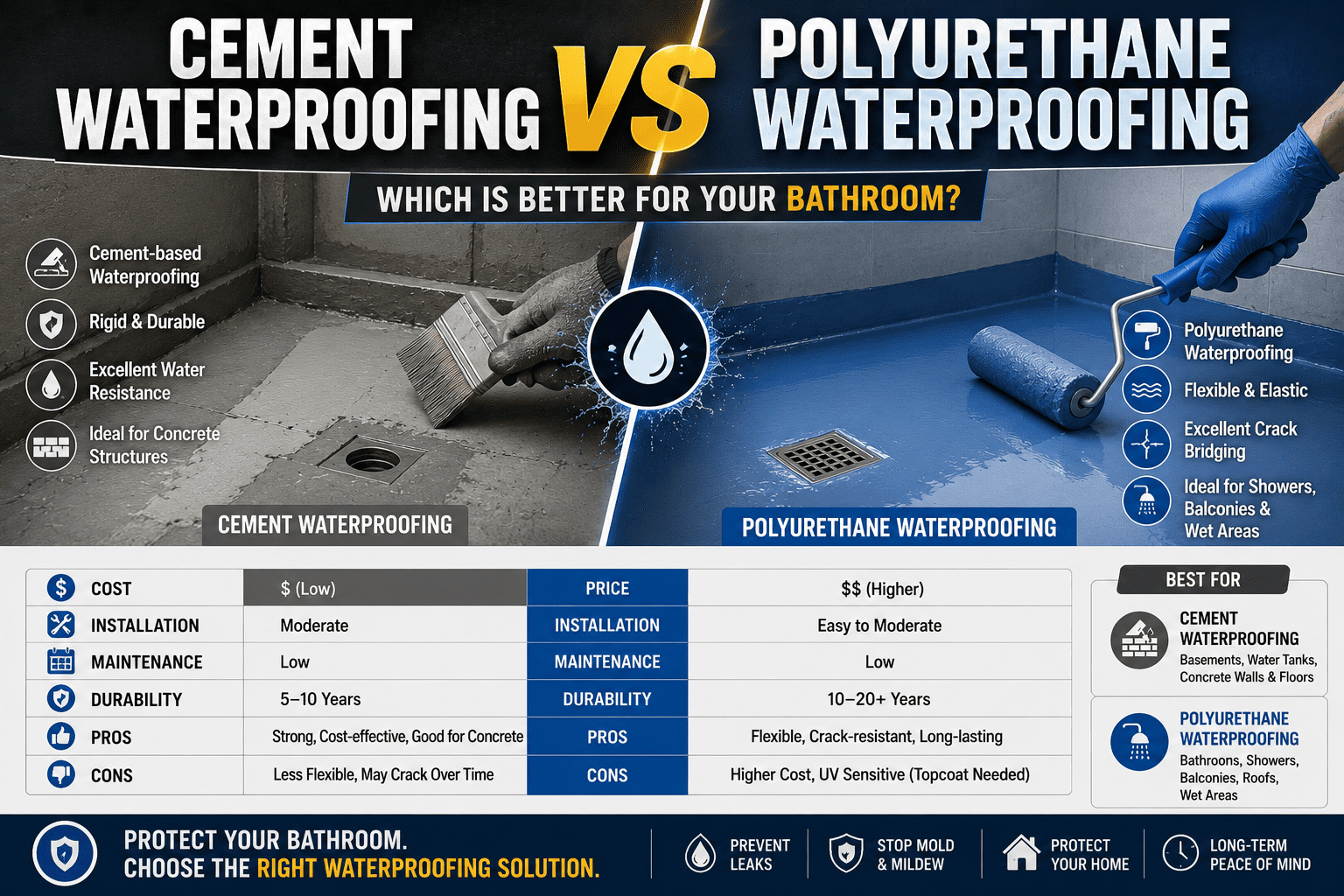
Cement Waterproofing vs Polyurethane Waterproofing Comparison Table
| Feature | Cement Waterproofing | Polyurethane Waterproofing |
|---|---|---|
| Typical Material Cost | Low to Medium | High |
| Installation Difficulty | Easy to Moderate | Moderate |
| Maintenance | Medium | Low |
| Flexibility | Low | Excellent |
| Crack Resistance | Limited | Outstanding |
| Average Lifespan | 10–15 years | 20–30+ years |
| Main Advantages | Affordable, DIY-friendly | Highly durable and flexible |
| Main Disadvantages | Rigid and prone to cracking | Higher cost |
| Best For | Budget bathrooms and concrete substrates | Premium bathrooms and high-moisture environments |
Real-World Installation Experience
Budget Family Bathroom
In a straightforward renovation with a stable concrete slab, we used cement waterproofing to keep costs under control. The bathroom performed well for over a decade with only minor grout maintenance.
Luxury Master Bathroom
For a high-end bathroom with large-format porcelain tiles and underfloor heating, we chose polyurethane waterproofing. Its flexibility reduced the risk of membrane cracking and protected a significant tile investment.
Older Homes with Structural Movement
In older houses where seasonal movement is common, polyurethane consistently outperforms cementitious systems because it can bridge small cracks instead of transferring stress directly to the membrane.
Performance Data and Expected Lifespan
Based on manufacturer specifications and field experience:
- Cement waterproofing typically lasts 10–15 years
- Polyurethane waterproofing often lasts 20–30 years or more
- Polyurethane can elongate several hundred percent, while cement coatings remain comparatively rigid
For more details on durability, see How Long Does Bathroom Waterproofing Last?.
Installation Details That Matter Most
Regardless of the material, successful waterproofing depends on careful installation.
- Substrates must be clean and dry
- Corners require reinforcement tape
- Drain connections must be sealed precisely
- Manufacturer curing times must be respected
- Flood testing is strongly recommended
Many failures are caused by installation shortcuts rather than material defects. Our guide on Most Common Bathroom Waterproofing Mistakes covers the most frequent problems.
Which Waterproofing Material Should You Choose?
Choose Cement Waterproofing If You:
- Need a lower-cost solution
- Have a stable concrete structure
- Are comfortable with DIY installation
- Want a widely available material
Choose Polyurethane Waterproofing If You:
- Want maximum durability
- Expect minor structural movement
- Are installing expensive tile finishes
- Need superior crack resistance
Common Mistakes to Avoid
- Applying waterproofing over dusty surfaces
- Skipping reinforcement at corners and joints
- Using insufficient coating thickness
- Tiling before the membrane fully cures
- Neglecting drain and pipe penetrations
Material Recommendations for Different Budgets
| Budget Level | Recommended Material | Reason |
|---|---|---|
| Economy | Cement Waterproofing | Cost-effective and reliable for stable substrates |
| Mid-Range | High-Quality Cementitious System | Improved additives and better durability |
| Premium | Polyurethane Waterproofing | Maximum flexibility and long-term protection |
Industry Standards and External Reference
About Our Renovation Experience
Frequently Asked Questions
1. Is polyurethane waterproofing worth the extra cost?
Yes. If you prioritize long-term durability and crack resistance, polyurethane often delivers the best value over time.
2. Can cement waterproofing be used in showers?
Yes. It is commonly used in bathrooms and showers, particularly when applied correctly over stable substrates.
3. Which system lasts longer?
Polyurethane typically lasts significantly longer, often exceeding 20–30 years.
4. Is cement waterproofing suitable for DIY projects?
Yes. Many homeowners find cementitious products easier to mix and apply than advanced elastomeric systems.
5. Can I apply polyurethane over cement waterproofing?
Only if the manufacturer specifically approves the combination. Compatibility should always be verified.
Conclusion
Cement waterproofing and polyurethane waterproofing each serve important roles in bathroom renovation. Cementitious systems are affordable, easy to apply, and highly practical for standard bathrooms with stable concrete structures. Polyurethane waterproofing, while more expensive, offers superior flexibility, crack resistance, and exceptional longevity.
In my professional experience, cement waterproofing is an excellent option for budget-conscious homeowners, while polyurethane is the best choice for premium bathrooms where long-term reliability is the top priority. Whichever material you choose, meticulous installation is the single most important factor in creating a bathroom that remains leak-free for decades.